Book Review: The Parasite Menace by Skye Weintraub
Last updated: June 2026 Reading time: 13 minutes
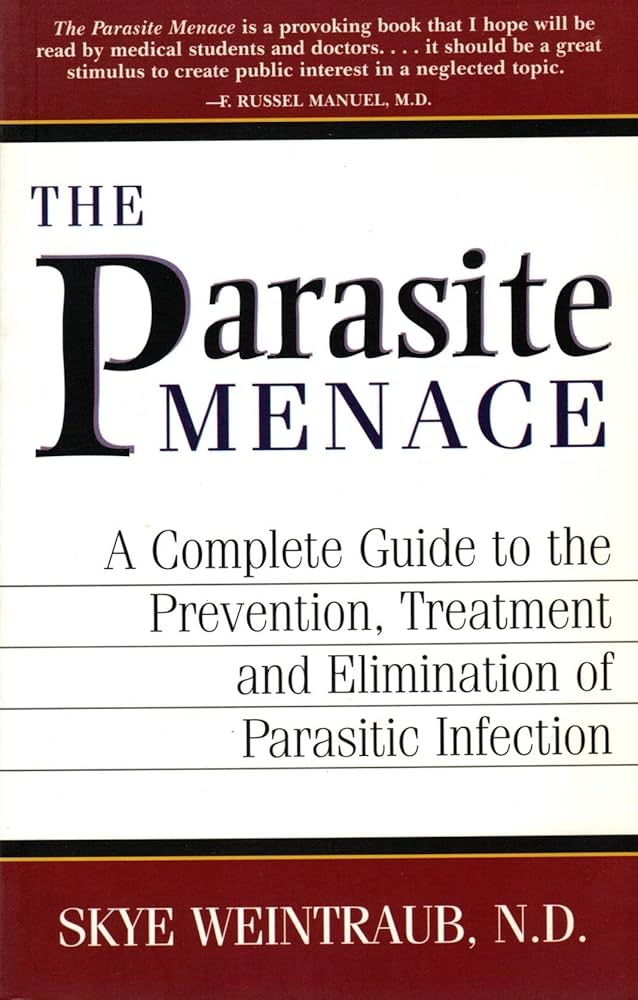
Most books about parasites are alarmist. They want you afraid and reaching for a product. Skye Weintraub's approach is different. She is a licensed naturopathic physician writing for the reader who has already decided parasites might be their problem and now needs to know what to do about it. The Parasite Menace is a clinical manual in popular-book form, organized around testing, treatment protocols, and the practical realities of actually getting parasites out of a body.
That makes it something specific and genuinely useful: the operational layer that books like Ann Louise Gittleman's "Guess What Came to Dinner" tend to leave out. Gittleman raised awareness. Weintraub answered the follow-up question.
The territory she covers is unglamorous and precise. Which tests are actually worth ordering. Which herbal compounds kill which organisms at which life stages. What dietary changes starve parasites while you're clearing them. How to recognize die-off and distinguish it from infection symptoms. What to do when a first protocol doesn't finish the job.
For anyone who has read themselves into certainty that parasites are contributing to their health picture and now needs a real map, this is one of the more useful books available. It rewards careful reading and discerning application, and that discernment is the same thing it requires.
Who Weintraub Is
Skye Weintraub practices as a licensed naturopathic physician. Her background is clinical, working with actual patients, not theorizing from a laboratory or writing from the supplement industry. That clinical orientation shapes the book's register throughout. She writes the way a practitioner with a waiting room talks: problem-focused, organized around what you can do next, cautious where caution is warranted.
The Parasite Menace sits in the tradition of integrative and naturopathic medicine that took parasite infection seriously before conventional gastroenterology paid much attention. That tradition includes Hulda Clark, Gittleman, and a cohort of functional medicine practitioners who found parasite protocols producing clinical results that standard care rarely matched. Weintraub is among the more methodical writers in that cohort. She is not a visionary making sweeping theoretical claims. She is a clinician recording what she has found useful.
The Core Thesis
Weintraub's argument is straightforward: parasites are more prevalent than mainstream medicine acknowledges, standard medical testing misses a substantial portion of infections, and this gap explains why many patients with chronic symptoms go unhelped for years.
From there, the book makes a clinical case. It moves through the categories of parasitic organisms, protozoa, nematodes (roundworms), cestodes (tapeworms), trematodes (flukes), with enough specificity that a reader can understand what type of organism they may be dealing with, where it tends to reside in the body, and what its known effects are. This is the kind of groundwork that gives the protocol chapters their context.
The central treatment framework draws on herbal antiparasitic compounds and dietary intervention, with attention to sequencing and the body's elimination pathways. Weintraub doesn't claim a single herb kills everything. She describes a multi-herb approach designed to address different organisms across different life stages, eggs, larvae, adult worms, and she pays attention to timing and supporting the liver and gut while a protocol runs.
She also takes seriously what happens after parasites die. Die-off in a loaded body is a real event, and she treats it that way rather than glossing over it as a minor inconvenience.
What the Book Contains
The practical scope of The Parasite Menace is wider than most parasite books manage.
The testing chapter is one of the book's stronger contributions. Weintraub addresses the well-documented problem that standard ova-and-parasite stool tests miss a large proportion of infections. Parasite egg shedding is inconsistent; many organisms reside in tissues rather than the gut; many clinically significant species aren't on the standard laboratory panel. She discusses which testing options she has found clinically more useful, including multiple-day sampling to account for inconsistent shedding and more comprehensive laboratory panels. Her position aligns with what functional-medicine practitioners and specialized laboratories have documented since: routine testing has low sensitivity, and a negative result doesn't mean a patient is clear.
This matters practically. Someone running a parasite protocol without testing is doing so in the dark, and someone who tested once with a standard panel and got a negative may still have an infection. Weintraub helps readers understand both limitations.
The herbal protocol discussion is thorough. The book covers the main herbal antiparasitics with track records in both traditional medicine and modern clinical use: black walnut hull, wormwood (Artemisia absinthium), cloves, pau d'arco, oregano oil, and others. She explains what each compound is thought to do and at what stage it acts, cloves, for example, are particularly important for penetrating parasite eggs that other herbs don't reach, a point that also appears in Hulda Clark's work and is worth taking seriously. The three-herb combination approach she describes has significant overlap with the Clark protocol in its constituent herbs, though Weintraub approaches sequencing and dosing differently and with clinical reasoning behind the choices.
Diet as a parallel intervention. The book treats dietary change as an active part of treatment, not a vague background suggestion. Sugar and refined carbohydrates feed the organisms. Raw garlic, pumpkin seeds, and other foods with documented antiparasitic properties are incorporated. This isn't unusual advice in naturopathic circles, but Weintraub grounds it in the treatment framework rather than treating it as optional self-improvement.
Elimination pathway support. Weintraub consistently returns to the principle that you need open elimination pathways before and during a protocol. Liver support, bowel regularity, adequate hydration, and binders to capture what organisms and their toxins release as they die, all of this receives attention. The approach tracks with the broader functional-medicine consensus that moving toxins without an exit route is a setup for feeling significantly worse.
Monitoring and retreatment. A section most protocol books skip: what to do when you don't feel clearly better, or when symptoms return. Weintraub treats protocols as things that may need to be repeated, adjusted, and combined with follow-up testing. This is honest clinical thinking rather than the implied guarantee that one round of herbs fixes everything.
What the Science Supports
The parasite-prevalence argument has meaningful support, though it is frequently overstated in alternative health circles and understated in conventional ones.
The CDC estimates that parasitic infections affect hundreds of millions of people globally, including populations in developed nations who are not typically regarded as at-risk. Giardia and Cryptosporidium circulate in municipal water supplies. Pinworm is endemic in children's settings. Toxoplasma gondii seroprevalence in the United States runs in the range of a third of the population. The standard clinical picture of parasites as a problem mainly for people who traveled to developing countries is incorrect, and Weintraub's assertion that conventional testing underestimates the problem is backed by documented sensitivity limitations in the laboratory literature.
The herbal compounds Weintraub recommends have real pharmacological activity. Juglone from black walnut hull has demonstrated anthelmintic and antimicrobial properties in laboratory research. Artemisinin from wormwood is the basis for mainstream antimalarial drugs. Eugenol from cloves has documented activity against multiple organisms. These are not folk remedies awaiting discovery: they are plants with centuries of documented use across traditional medical systems and, increasingly, phytochemical characterization in the research literature.
The basic clinical principle Weintraub operates from, that addressing parasites improves chronic symptoms that don't respond to other interventions, is consistent with functional medicine clinical experience even though large, well-controlled human trials on herbal parasite protocols are scarce. The absence of those trials reflects the economics of pharmaceutical research, not negative findings.
Where the Book Asks for Discernment
Several areas require the reader to bring their own judgment to what Weintraub presents.
Testing recommendations age quickly. The landscape of functional-medicine laboratory testing changes, and what was a leading-edge option at the time of writing may have been superseded, discontinued, or updated. Readers should treat her testing guidance as a framework for the right questions to ask, not a current directory of specific laboratories or panels.
Specific dosing details warrant professional oversight. Weintraub writes for an intelligent self-directing reader, and some of the dosing information in the protocol chapters is detailed enough that it can be treated as a self-treatment guide. This is where caution is warranted. Several of the herbs involved, particularly wormwood, have real contraindications and interaction potential. The book itself does not substitute for working with a practitioner who can assess your specific situation, review your medications, and monitor your response. Self-treatment with herbal antiparasitics isn't dangerous for most healthy adults starting low and going slow, but the more complex the health picture, the more valuable a clinical relationship becomes.
The symptom-to-parasite mapping is a clinical framework, not a diagnostic algorithm. Weintraub connects specific symptom patterns to specific types of organisms or colonization sites. This is useful clinical thinking, and it reflects genuine patterns practitioners have observed. It is not a validated diagnostic system. A reader who maps their symptoms against her descriptions and concludes they have a specific organism cannot use that mapping as a substitute for testing.
Die-off is real but variable. The book's treatment of Herxheimer-type reactions, the worsening of symptoms as organisms die and release their contents, is accurate as a general phenomenon. But die-off severity varies enormously between individuals and doesn't reliably predict effectiveness. Some people feel dramatically worse during a successful protocol. Others feel little change even when testing later shows clearance. This variability is worth knowing before you start.
How This Fits a Real Protocol
The book's practical value is highest when it is used as a clinical map alongside actual testing and, ideally, practitioner support, not as a stand-alone self-treatment guide to run in isolation.
The most useful sequence Weintraub describes aligns with what integrative practitioners generally recommend: assess and prepare elimination pathways first, run the protocol, manage die-off with binders and support, retest. For the full implementation framework, the MadWorldDetox parasite protocol lays out the sequencing step by step. The full moon parasite cleanse protocol covers timing approaches that many practitioners now layer on top of continuous herbal treatment.
Binder use during a protocol is one of the most underrated parts of the approach, and Weintraub gives it appropriate attention. The best binders for detox guide covers the options and their tradeoffs in more detail than the book can accommodate.
Die-off management is where protocols succeed or fail experientially. If someone gets hit hard and doesn't understand what's happening, they stop. The die-off symptoms guide is the companion piece for that window.
For context on how this book fits into the broader parasite literature, the review of Gittleman's Guess What Came to Dinner covers the book that opened the door for most readers. Weintraub walks through it.
Who Should Read It
The Parasite Menace is written for someone already past the question of whether parasites matter and now asking what to do. If you're still in the "is this even real?" phase, Gittleman's book is the better starting point.
Read it if:
- You have reason to suspect parasites are part of your health picture and want a clinically organized guide to testing and treatment
- You're working with a naturopathic or functional-medicine practitioner and want to understand the herbal protocol framework more deeply
- You've already run one protocol and want to understand retreatment options and why a first round might not have finished the job
- You want a more thorough treatment of testing limitations than you'll find in most popular books on the subject
Read it with caution if:
- You have a complex medication list, verify every herb for interaction potential before starting
- You are pregnant or nursing, wormwood and several other compounds in the protocol are contraindicated
- You have a serious illness for which you're receiving conventional treatment, use this as a complement, not a replacement
- You're prone to interpreting every symptom flare as evidence of a worsening infection. The psychological experience of a parasite protocol can be difficult, and someone with health anxiety may find the die-off window particularly hard to navigate without practitioner support
Not the right book if:
- You want peer-reviewed trial evidence at each protocol step. This is clinical naturopathic medicine, not pharmaceutical medicine. The evidentiary standard is traditional use, phytochemical research, and clinical observation rather than large RCTs.
- You need an urgent medical assessment. If you have significant symptoms, rule out serious pathology with appropriate medical evaluation before attributing things to parasites.
The Bottom Line
The Parasite Menace does something specific and does it well: it takes you from suspicion to organized clinical action. The author is a practitioner, not a theorist, and the book reads like one. The testing chapter is genuinely valuable for understanding why a negative conventional test means less than it appears to. The protocol framework is coherent, grounded in plants with real activity, and organized around the principles that integrative practitioners have found effective.
The limitations are worth naming: testing recommendations may have been superseded, dosing details need practitioner oversight for complex situations, and the symptom-to-organism mapping is a clinical heuristic rather than a validated system. This is a book to read as a skilled guide, not as a prescription.
For readers willing to use it that way, it fills a gap that most parasite books leave open. The awareness literature tells you the problem exists. This book tells you what to do about it.
Related MadWorldDetox Guides
- Parasite Protocol - Full MadWorldDetox implementation guide: testing, sequencing, binders, monitoring
- Full Moon Parasite Cleanse Protocol - Timing framework for running herbal protocols with the lunar cycle
- Best Binders for Detox - Capturing what parasites release as they die, and choosing the right binder for your protocol
- Die-Off Symptoms Guide - What Herxheimer reactions look like during a parasite cleanse and how to manage them
- Book Review: Guess What Came to Dinner by Ann Louise Gittleman - The awareness book that pairs with this protocol manual
Products Mentioned
The Book:
The Parasite Menace - Skye Weintraub, N.D. Clinical guide to parasite testing, herbal treatment protocols, dietary intervention, and die-off management.
Affiliate Disclosure: This review contains affiliate links. We may earn a small commission on purchases made through these links at no additional cost to you. We only recommend books and products we've researched and believe provide value. Our assessment of the book itself is independent of any affiliate relationship.
Last updated: June 2026