Book Review: Guess What Came to Dinner: Parasites and Your Health by Ann Louise Gittleman
Last updated: June 2026 Reading time: 16 minutes
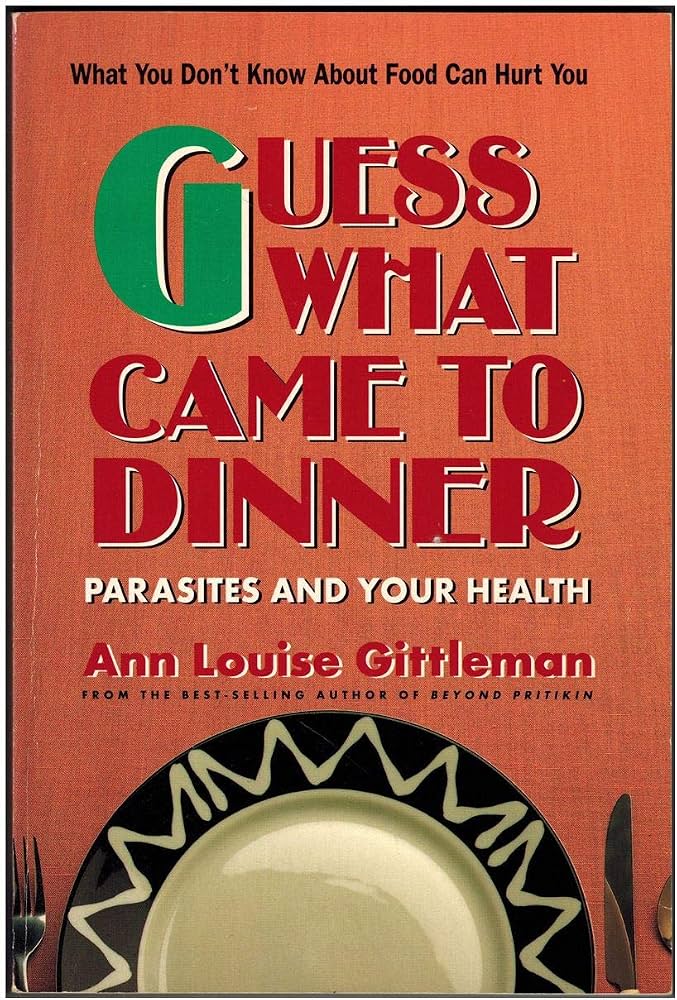
Most people reading this book in 2001 had never once considered that what was making them tired, bloated, itchy, anxious, or inexplicably unwell might be living inside them. Mainstream medicine certainly wasn't asking the question. Parasites were tropical diseases, something you caught in developing countries, something a stool test would catch if you had them.
Ann Louise Gittleman argued otherwise.
Her case, assembled over more than two hundred pages, is simple and unnerving: parasites are not rare, not primarily tropical, and not reliably detectable by the tests most doctors order. They are, she contends, one of the most underappreciated drivers of chronic symptoms in the developed world. People cycle through diagnoses, treatments, and specialists for years without anyone checking whether an uninvited organism might be running part of the show.
"Guess What Came to Dinner" was not the first book to raise this possibility. Hulda Clark's work preceded it. But Gittleman, a nutritionist with mainstream credentials and a less sensational writing style, brought the parasite conversation to an audience that would have dismissed Clark outright. The book sold widely, earned a revised edition, and became the entry point for a generation of practitioners now routinely screening for parasites in functional medicine contexts.
This review takes that argument seriously, examines where it holds up, and is honest about where it doesn't.
Who Ann Louise Gittleman Is
Gittleman is a New York Times bestselling author and nutritionist whose career spans four decades. She holds a master's degree in nutrition education from Columbia University and trained under Nathan Pritikin before developing her own perspective, which eventually broke with Pritikin's low-fat orthodoxy.
Her broader body of work covers bile acids, copper toxicity, fatty acid metabolism, and hormonal health. She has written more than thirty books. The parasite work fits within a larger project of identifying underappreciated contributors to chronic illness, things mainstream clinical practice overlooks because the financial incentives don't run toward investigating them.
Her authority on parasites specifically comes from clinical observation over years of client work, from the academic literature on parasitology she compiled into the book, and from interviews with researchers and practitioners in the field. She is not a parasitologist by training. That matters, and we'll address it in the assessment.
The Core Thesis
Gittleman's central argument runs like this: parasites are far more prevalent in Western populations than the standard medical narrative acknowledges, testing is far less reliable than most physicians assume, and the organisms' physiological effects are far more diverse than their tropical-disease reputation suggests.
She organizes her case around several interlocking claims.
Prevalence is underestimated. Gittleman draws on epidemiological data and surveillance reports to argue that a significant portion of the population in the United States and comparable countries carries at least one parasitic organism at any given time. The common assumption that parasites require travel to endemic regions is simply false. Domestic water supplies, commercially grown produce, international food imports, household pets, and contact with infected individuals all represent transmission routes that don't require leaving the country.
Testing is structurally inadequate. The standard ova-and-parasite stool test has meaningful false-negative rates. Many parasites don't shed eggs continuously, so a test collected on the wrong day comes back clean. Organisms that inhabit tissues rather than the intestinal lumen won't appear in stool at all. Species outside the short list of commonly screened pathogens go undetected. The test tells you only that the specific organisms it tests for weren't shedding that day, which is a narrower statement than most clinicians communicate to patients.
Symptom profiles are broader than expected. The conventional picture of parasitic infection runs toward diarrhea, weight loss, and acute gut distress. Gittleman documents a wider range of presentations: chronic fatigue, joint pain, skin conditions, food sensitivities, anxiety and mood disturbances, sleep disruption, and digestive symptoms that don't resolve even with dietary changes. The argument is not that parasites cause all of these conditions, but that they can be a contributing factor that a clinician who isn't looking for them will miss.
Eradication is possible through herbal and pharmaceutical means. The book outlines both approaches and describes what dietary and hygiene measures support them.
What the Book Actually Contains
"Guess What Came to Dinner" is organized into a broad survey of parasite types, a section on transmission and risk factors, a chapter on symptoms and their parasitic correlates, guidance on testing, and a protocol section on treatment and prevention.
The organisms she covers include protozoa (Giardia, Cryptosporidium, Blastocystis hominis, Entamoeba species), helminths (roundworms, tapeworms, pinworms, hookworms, Strongyloides), and flukes. She gives each enough clinical description to help a reader understand how each class of organism behaves differently, where it tends to reside, and what it disrupts.
The transmission chapter is one of the book's more practical contributions. Gittleman maps out pathways that a reader can actually do something about: inadequate handwashing, undercooking meat, raw fish consumption, contaminated water sources including municipal supply, produce handling, pet contact, and person-to-person spread in household settings. This is not fear-mongering. It is an accurate account of how parasitic organisms circulate in ordinary domestic life.
The symptom chapter is where the book's usefulness and its overreach occupy the same pages. The symptoms she associates with parasitic infection include many that genuinely do appear in documented parasitic disease, and many others where the evidence of a parasitic cause is far thinner. She sometimes writes with more certainty than the underlying research warrants.
The testing section is genuinely useful. She explains in plain terms why a single stool test may miss an infection and what a more rigorous approach looks like, including purged samples, multiple specimens collected on different days, and expanded species panels. This is information most patients don't get from the clinician who orders a standard test and reports it negative.
The treatment section covers pharmaceutical antiparasitic drugs (she is factual about what they do and when they're appropriate) and herbal protocols. Her preferred herbal approach includes black walnut hull, wormwood, and cloves, the same combination Hulda Clark used and one with a long ethnobotanical foundation. The mechanism she describes for this combination has not been validated in rigorous clinical trials, but the individual constituents have documented antiparasitic activity in the research literature.
What Science Supports
Several of Gittleman's core contentions have only become more defensible since the book's publication.
Parasite prevalence in the developed world is real and underdiagnosed. The CDC estimates that tens of millions of Americans are affected by parasitic infections. Toxoplasma gondii alone is estimated to infect a third of the global population. Giardia is the most commonly diagnosed intestinal parasite in the United States. Blastocystis hominis, which Gittleman covered when it was barely discussed in clinical medicine, is now recognized as a frequently detected organism whose pathogenicity remains an active research question. The framing of parasites as primarily a developing-world problem has always been wrong, and functional medicine's eventual move toward routine parasite screening represents a partial vindication of what Gittleman was arguing two decades before it became standard practice in integrative contexts.
Standard testing misses infections. This is well documented. Multiple studies have confirmed that single stool specimens with conventional ova-and-parasite examination have poor sensitivity for many common organisms. The shift toward PCR-based stool panels in functional medicine practice represents an acknowledgment that the old tests were inadequate exactly as Gittleman described.
The herbal antiparasitic compounds have documented activity. Black walnut hull contains juglone, which shows anthelmintic properties. Wormwood contains artemisinin, the compound that became the basis for modern antimalarial pharmaceuticals. Cloves contain eugenol, which has demonstrated activity against parasites including, importantly, penetration of eggs that most antiparasitic compounds miss. These are not magic or fringe compounds. They are plants with centuries of traditional use whose active constituents have been studied.
Parasite-driven symptoms extend beyond obvious gut distress. The medical literature supports associations between various parasitic infections and chronic fatigue, joint pain, skin manifestations, and mood disturbances. These connections are more established for some organisms and contexts than others, but the idea that a parasitic infection presents only as diarrhea is clinically inaccurate.
What Is Overstated
The book's weaknesses follow from the same source as its strengths: Gittleman is a clinician and researcher writing for a general audience, and the pressure to make the argument legible and actionable pushes her at times toward certainty the evidence doesn't support.
The causal link between specific parasites and specific symptoms is often asserted, not demonstrated. Gittleman sometimes writes as if the presence of a parasite is sufficient explanation for a symptom cluster, without adequate acknowledgment that correlation is being dressed as causation. Someone with chronic fatigue and a positive test for Blastocystis may not have fatigue because of Blastocystis. The organism might be incidental. This distinction matters enormously for treatment decisions.
The coverage of Blastocystis and related organisms treats contested science as settled. The pathogenicity of several of the protozoa she covers was genuinely debated at the time of writing and remains so. She tends to present the pathogenic reading as the correct one, which the field has not confirmed.
The symptom list is broad enough to implicate almost anyone. When fatigue, joint pain, food sensitivities, brain fog, anxiety, skin issues, and digestive complaints all appear on the list of potential parasite symptoms, the framework risks becoming unfalsifiable. Any symptomatic person might be told they have parasites, try a protocol, improve for reasons that could include many factors, and attribute the improvement to parasite elimination. Without controlled evidence, this chain of reasoning doesn't hold.
The book does not distinguish between organisms with robust clinical evidence of harm and those whose impact is speculative. A reader who finishes it may come away treating all parasite findings with the same urgency, when the clinical significance of different organisms varies enormously.
Who Benefits from This Book
People with chronic, unexplained symptoms who have had standard workups that came back unremarkable. If a clinician has run conventional tests, found nothing, and offered symptom management without etiological clarity, this book represents a framework that might explain what's been missed. That's genuinely valuable.
People who have had known exposure risk. Extensive international travel, regular consumption of raw or undercooked animal products, rural water sources, or household contact with infected individuals all raise the prior probability that a parasite is in the picture. For this population, the book is a useful primer.
Practitioners looking to understand what their patients are reading. Many people arrive at functional medicine or naturopathic clinics carrying this book or ideas derived from it. Understanding the argument clearly helps practitioners engage with it rather than dismiss it.
Anyone doing a parasite cleanse protocol. The book provides context that makes the protocol more intelligible, even if the causal claims aren't all settled.
Who Should Approach It Carefully
People prone to health anxiety. The broad symptom list and the framing of parasites as pervasive and underdetected can activate health anxiety in ways that lead to over-testing, over-treating, and a kind of diagnostic tunnel vision where parasites become the explanation for everything. The book does not provide strong enough guardrails against this pattern.
Anyone considering herbal antiparasitic protocols without medical supervision if they are pregnant, nursing, taking pharmaceuticals, or have liver disease. Wormwood is contraindicated in pregnancy. Black walnut hull and wormwood both have meaningful drug interaction profiles. This is not a DIY situation for people in those categories.
Those who take the book as diagnostic confirmation. A positive response to the book's symptom checklist is not a diagnosis. The testing section, read carefully, explains why. The symptom patterns Gittleman describes overlap with many other conditions. Before treating for parasites, get tested by a practitioner who can order an expanded panel, interpret the results in clinical context, and rule out other explanations.
Anyone who skips professional testing entirely. Gittleman does not recommend skipping testing, to her credit. But some readers extract the protocol and run it without confirming an infection exists. Herbal antiparasitics are not harmless. Die-off reactions, when parasites are present, can be intense. Starting a protocol without understanding what you're treating and how to support elimination pathways is a mistake regardless of what the book implies.
How It Fits a Real Detox Practice
Parasites disrupt the gut environment in ways that compound everything else. An organism drawing on your nutritional resources, triggering immune activation, degrading the mucosal lining, and producing metabolic waste products doesn't make any other detox intervention work cleanly. This is the practical reason parasite work belongs in a detox sequence at all.
The sequencing matters. Before starting a parasite cleanse, elimination pathways need to be open. Liver and kidneys need to be functional. If you push parasites and their metabolites out of tissues without adequate support for processing and excreting them, die-off symptoms escalate and outcomes get worse. The die-off symptoms guide covers what to expect and how to manage it. The best binders for detox covers what to add to help move what gets released.
The full moon timing that many practitioners now use as a supplement to any antiparasitic protocol is not something Gittleman covers explicitly, but the full moon parasite cleanse protocol is a natural pairing with the herbal approach she describes. Parasite reproductive activity increases around the full moon, and timing interventions to coincide is a refinement worth understanding.
Gittleman's book is also usefully read alongside the existing Hulda Clark protocol guide, Clark's approach is more intensive and more contested, and Gittleman's more measured version helps calibrate what a reasonable starting point looks like versus what requires more conviction and clinical support. The companion book review of The Cure for All Diseases covers that territory in full.
For anyone working through the parasite protocol, Gittleman provides the background that makes the protocol make sense rather than feel like following instructions without understanding why.
The Bottom Line
"Guess What Came to Dinner" is the book that moved parasite awareness from fringe to functional medicine mainstream. It did that by making the argument carefully enough to be taken seriously: not by claiming that parasites cause all disease, but by documenting that they're common, that standard testing misses them, and that the symptom profiles are broader than clinicians were trained to expect.
That argument has held up better than most alternative health claims from the same era. The functional medicine shift toward expanded stool panels, the increasing recognition of organisms like Blastocystis in chronic illness contexts, and the growing body of work on parasites as immune modulators all move in the direction Gittleman was pointing.
The book's weaknesses are also real. The causal certainty often outruns the evidence. The symptom net is wide enough to catch almost anyone. The absence of adequate cautions around herbal protocols in vulnerable populations is a meaningful gap. And a reader who finishes the book with the conviction that parasites explain all their problems has read it too completely.
The version of this book worth taking seriously is the one that says: these organisms are common, testing has historically been inadequate, the clinical presentations are diverse, and if you have unexplained chronic symptoms, it is worth ruling parasites out properly rather than assuming they're absent because nothing showed on a standard panel. That argument is solid. The more ambitious claims around specific symptom-parasite correlations require more skepticism and, before treatment, better evidence from an expanded panel.
Read it as an introduction to a territory that mainstream medicine underinvested in for decades, then work with a practitioner to determine whether any of it applies to you specifically.
Related MadWorldDetox Guides
- Parasite Protocol - The full MWD parasite cleanse protocol, sequenced and dosed
- Full Moon Parasite Cleanse Protocol - Timing your protocol around the lunar cycle when parasite activity peaks
- Hulda Clark Protocol Guide - The more intensive parallel approach, with detailed implementation notes
- Best Binders for Detox - Supporting excretion during any antiparasitic protocol
- Die-Off Symptoms Guide - Managing Herxheimer reactions when parasites clear
- Book Review: The Cure for All Diseases by Hulda Clark - The more radical version of the parasite argument, reviewed with the same honesty
Products Mentioned
The Book:
Guess What Came to Dinner: Parasites and Your Health - Ann Louise Gittleman. Avery, 2001. The book that mainstreamed parasite awareness in alternative health.
Affiliate Disclosure: This review contains affiliate links. We may earn a small commission on purchases made through these links at no additional cost to you. We only recommend books and products we've researched and believe provide value. Our assessment of the book itself is independent of any affiliate relationship.
Last updated: June 2026