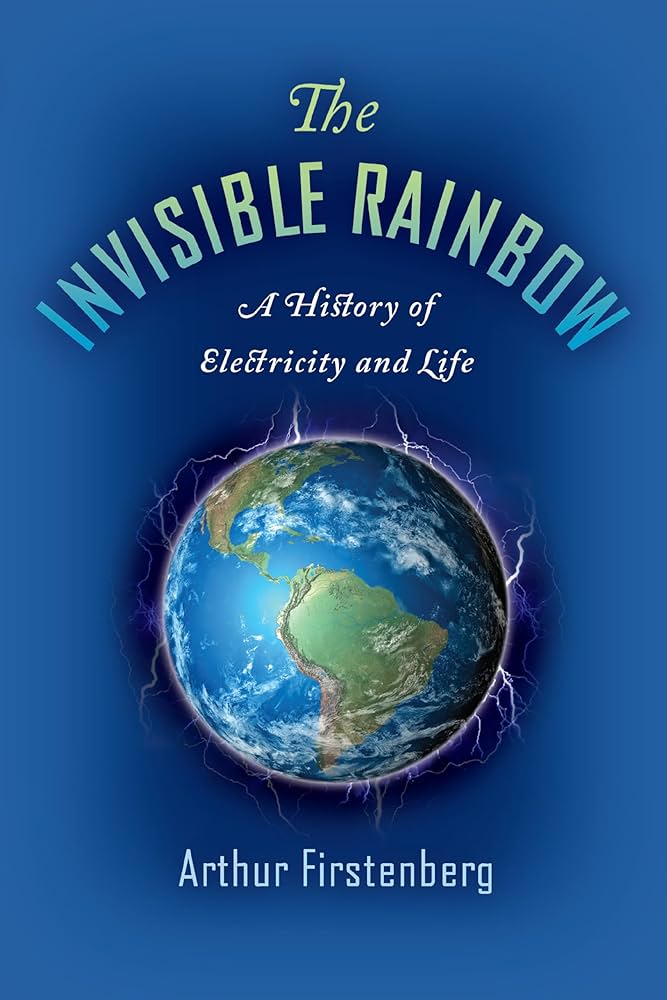
Book Review: The Invisible Rainbow: A History of Electricity and Life by Arthur Firstenberg
Last updated: June 2026 Reading time: 16 minutes
Every time a major electrical technology spread through the Western world, a wave of illness followed shortly after. Firstenberg documents this pattern across more than two centuries, and the correlations he assembles are difficult to dismiss casually.
The flu epidemic of 1889, the one that preceded the 1918 Spanish flu by three decades, arrived when telegraph lines had just completed a global network. The 1918 pandemic itself, now the most studied mass death event in modern history, hit hardest in cities and among populations with the most radio exposure, not the most person-to-person contact. Rural populations and isolated communities sometimes showed lower rates. The timing of electrification and the timing of disease, Firstenberg argues, have tracked each other for so long that the correlation deserves something more than silence.
"The Invisible Rainbow: A History of Electricity and Life" is Arthur Firstenberg's life work. It took more than three decades to research and write. It runs to nearly five hundred pages. It draws on medical records, utility company rollout data, military communications logs, and the writings of physicians contemporary to each wave of electrification. Firstenberg is not writing a blog post. He is making a case, brick by documented brick, that the electromagnetic environment the human body operates inside has changed more radically in the past two centuries than in any prior period of evolutionary history, and that this change has not been neutral.
This review takes the book seriously, which means reading it on its own terms first. Firstenberg's argument deserves a real steelman before a real critique. The historical correlations he assembles are genuinely interesting. The questions he raises about our electromagnetic environment are legitimate. Where he overreaches is also worth naming plainly.
This is a read, not a decree.
Who Arthur Firstenberg Is, and Why This Book Took 30 Years
Firstenberg attended Cornell University and the University of California, Irvine School of Medicine before leaving medicine when he developed electrosensitivity that he attributes to the use of fluorescent lights during clinical rotations. He is not a crank who stumbled across the EMF literature from the outside. He came at this problem from inside medical training and then spent the rest of his career working through what he believes happened to him and to others.
He founded the Cellular Phone Task Force in 1996, an advocacy organization that has operated continuously for three decades. He wrote "The Invisible Rainbow" across multiple country residences, moving when his electrosensitivity made a given location unlivable. That is part of the biographical context a reader needs. Firstenberg writes as someone personally invested in the thesis, not as a disinterested historian.
This does not automatically disqualify the research. Personal investment can produce rigorous work. The question is whether the evidence holds up on its own, and there the answer is genuinely mixed.
The Central Thesis: Electrification as the Missing Variable in Disease History
Firstenberg's core argument runs as follows.
Before the electrical age, human beings lived inside an electromagnetic environment that was essentially static: the earth's natural magnetic field, atmospheric electricity, and the extremely low-frequency signals from lightning. These signals were stable for hundreds of millions of years, long enough that every organism on the planet evolved within them.
Starting in the mid-1700s with the first electrical experiments, and accelerating from the 1880s onward with the rollout of the electrical grid, human beings introduced a new category of electromagnetic signal into this environment. Power lines. Telegraphs. Radio. Radar. Microwave ovens. Cell towers. WiFi. 5G. Each technology added new frequencies, new intensities, and new modulations that had never existed in evolutionary history.
Firstenberg argues that biological systems are not passive to these signals. The nervous system runs on electrical impulses. The heart's rhythm is electromagnetic. Cell membranes respond to voltage gradients. Cellular signaling, enzyme activity, and gene expression all involve electromagnetic processes at the molecular level. From this observation, he draws a direct line: if the electromagnetic environment changes dramatically, biology will respond.
The pandemic history is where he builds his most provocative case. Flu pandemics have followed major expansions of electrical technology with a regularity that he documents in considerable historical detail. The timing of the 1889 pandemic with global telegraph completion. The 1918 pandemic and the rapid expansion of military radio. A wave of illness in 1968 that aligned with the launch of early telecommunications satellites. Each correlation is documented in period sources, not invented.
The subtitle matters: this is presented as a history. Firstenberg is not primarily arguing mechanism in this book. He is arguing pattern.
The Historical Correlations Firstenberg Assembles
The most valuable section of "The Invisible Rainbow" for a careful reader is its documentary approach to disease history.
Firstenberg pulls from medical journals of the 1880s and 1890s and finds consistent physician observations. Physicians reporting strange new cases of fatigue, cardiac irregularity, and nervous exhaustion in cities where electrical equipment had just been installed. These weren't fringe observations. They appeared in mainstream journals of the period, from doctors who had no ideological stake in the outcome and no "EMF awareness" framework to speak from.
He documents what was called "neurasthenia" in the late nineteenth century and traces its geographic and temporal distribution against telegraph and then electrical grid rollout. Neurasthenia meant nervous exhaustion, and it appeared first in cities, first along rail and telegraph routes, and spread as those routes spread. Physicians of the time noticed this distribution and commented on it.
On influenza, Firstenberg makes a careful observation that should at least prompt questions. Standard germ theory holds that the 1918 flu spread via person-to-person contact. But the pandemic appeared almost simultaneously across geographically isolated locations in the spring of 1918. Remote Alaskan villages, island populations with limited external contact, and military camps in the American midwest all reported cases within short windows of each other. The conventional explanation is that the virus spread faster than anyone expected. Firstenberg's explanation is that radio wave exposure triggered symptoms across populations simultaneously.
He does not claim that viruses don't exist or that germ theory is wrong. He argues that electromagnetic signals may weaken immune function or trigger cellular stress responses that make an organism vulnerable to viruses it would otherwise fight off successfully.
That is a different claim from the one his critics usually argue against.
On electrical hypersensitivity, the body of research he assembles on the historical recognition and then abandonment of this diagnostic category is interesting regardless of where you stand on mechanism. Physicians through the 1920s documented what they called "electrical sensitivity" in patients exposed to power lines and electrical equipment. The diagnosis existed, appeared in clinical literature, and was then quietly dropped from medical vocabulary as electrical infrastructure became an economic reality too large to challenge.
Where the Argument Is Genuinely Compelling
The most defensible portion of Firstenberg's argument is his documentation of non-thermal biological effects.
For decades, official safety standards for electromagnetic radiation were set based on thermal effects only. The regulatory question was whether a given signal was strong enough to heat tissue. If not, it was declared safe. This was not a scientific finding about biology. It was a regulatory shortcut.
The research literature on non-thermal effects is larger and more established than most people know. Cell membrane permeability changes at exposure levels far below tissue-heating thresholds. Voltage-gated calcium channels respond to electromagnetic stimulation. Oxidative stress markers shift under RF exposure in multiple peer-reviewed studies. A 2019 review in Environmental Health estimated that the majority of peer-reviewed studies examining low-level non-thermal RF effects found biologically significant changes.
Firstenberg did not invent these findings. They exist in the literature. His contribution is situating them inside a historical narrative that makes the current regulatory framework look not just inadequate but structurally motivated to remain so.
The argument that telecommunications infrastructure expanded faster than any safety research could follow it is demonstrably true. 4G was deployed with essentially no long-term safety data. 5G infrastructure was deployed with even less. The honest position is not that 5G is proven dangerous, but that it is genuinely unproven safe at population scale over decades, and that the agencies tasked with determining safety have had economic and military reasons to define safety narrowly.
That structural critique stands up. The historical documentation of prior disease correlations is worth knowing. The dismissal of non-thermal effects in mainstream regulatory science is a real and documented problem.
Where Mainstream Science Pushes Back
The book has genuine weaknesses, and a reader who wants to use it well needs to name them.
The correlation-causation problem is fundamental and Firstenberg does not fully resolve it. The 1880s brought not only electricity but also urbanization, industrialization, dietary change, new patterns of indoor living, factory pollution, and new densities of human contact. Pulling electricity out as the key variable across that entire bundle of changes requires more than temporal correlation, and the book does not provide controlled analysis that isolates electrical exposure from these other variables.
On the 1918 pandemic, the radio hypothesis runs into a specific empirical problem. Military radio stations were heavily concentrated in certain regions and absent in others. If radio exposure triggered the pandemic or worsened outcomes, we would expect the worst mortality in regions with the densest radio infrastructure. The mortality geography of 1918, when examined carefully, does not map cleanly onto radio transmission geography. The nearly simultaneous appearance of cases across isolated locations has other explanations in the literature, including the nature of this particular virus and the role of military mobilization in distributing carriers. Firstenberg presents the correlation. He does not rule out the competing explanations.
On electrosensitivity, the picture is more complicated than the book suggests. Double-blind provocation studies, where people who report electrosensitivity are exposed or not exposed to EMF without knowing which condition they're in, have consistently found that self-reported electrosensitive individuals cannot reliably detect the presence or absence of an electromagnetic field above chance. This finding does not mean that people who report these symptoms are lying or that their symptoms are not real. It means the trigger may be more complex than direct electromagnetic sensitivity, and could involve conditioned responses, anxiety, or still-uncharacterized mechanisms. Firstenberg's treatment of this research is dismissive in a way that does not serve the reader.
The section on 5G makes claims about millimeter waves and skin penetration that are more confident than the available data supports. Millimeter waves do not penetrate beyond skin and do not reach internal organs. Whether skin effects have downstream physiological consequences is genuinely uncertain, but the book reads with more certainty than the evidence earns.
Finally, the implied mechanism throughout the book, which is that electromagnetic signals at non-thermal levels directly trigger disease, is a hypothesis, not an established finding. The cellular and molecular-level effects that have been documented in the research literature are real, but connecting them causally to the epidemic-scale disease waves Firstenberg describes requires a chain of inference that peer-reviewed evidence has not closed.
How to Read This Book Without Either Buying or Dismissing the Whole Thing
"The Invisible Rainbow" rewards careful reading and resists wholesale acceptance or rejection.
The historical documentation of physician observations and disease distribution around electrification is worth reading on its own terms. These are primary sources. They existed before Firstenberg constructed a thesis around them. Whatever you conclude about mechanism, the pattern he documents is historically real and underexplored.
The structural critique of regulatory capture in setting EMF safety standards is sound and applies beyond this book. The agencies that set exposure limits have had interests that do not align perfectly with independent safety research, and the non-thermal effects literature has been systematically underfunded relative to thermal-only frameworks.
Where to be skeptical: the causal claims, especially around influenza pandemics and 5G. Hold these as provocative hypotheses rather than demonstrated findings. The book gives you the correlation; it does not give you the experiment that rules out alternative explanations.
For anyone already reducing EMF exposure based on the precautionary case, this book provides historical and scientific context for that position. The EMF radiation protection guide covers practical reduction strategies. The grounding and earthing guide addresses the other side of the electromagnetic relationship, reconnecting to the earth's natural field.
If you've read Nicolas Pineault's more accessible entry point, The Non-Tinfoil Guide to EMFs, Firstenberg's book is the deep historical layer underneath that practical primer. Pineault gives you what to do. Firstenberg gives you two hundred and forty years of reasons why the question is not paranoid.
For the tools side of EMF reduction, the EMF protection tools guide and the earthing and grounding guide offer practical starting points that don't require accepting Firstenberg's full causal thesis.
Who Should Read This Book
Read it if:
- You want the deepest, most thoroughly sourced historical case for taking electromagnetic pollution seriously
- You've already read the practical EMF literature and want the historical and scientific foundation underneath it
- You're willing to engage with a long, dense argument and distinguish what is documented from what is inferred
- You are skeptical of regulatory science on EMF and want primary source material to understand why that skepticism has roots
Read it carefully, with skepticism, if:
- You tend to take ambitious alternative health arguments at face value. This book makes large claims on historical correlations and the reader needs to hold the correlation-causation distinction actively through five hundred pages.
- You have health anxiety around electromagnetic exposure. Firstenberg does not write for calm distance. The cumulative effect of the book can be alarming, and alarm is not necessarily proportional to demonstrated risk.
Put it down, or read it last, if:
- You are new to the EMF question. Start with the Pineault book. Firstenberg's argument requires enough background that newcomers may accept the whole framework because they lack the context to push back on it.
The Bottom Line
"The Invisible Rainbow" is the most ambitious EMF argument in print. It is also an honest reader's most challenging EMF read, because separating what Firstenberg documents from what he infers requires sustained attention.
What he documents is real and worth knowing: two centuries of physician observations correlating new electrical technologies with new illness patterns, a regulatory framework built on thermal-only safety assumptions that the research literature on non-thermal effects has consistently undermined, and a history of electromagnetic hypersensitivity as a clinical concept that was recognized and then quietly abandoned as electrical infrastructure became too economically central to challenge.
What he infers goes further than the evidence supports. The causal chain from electromagnetic signal to epidemic disease remains unproven. The influenza pandemic correlations, while historically interesting, have competing explanations that Firstenberg does not adequately address. The double-blind electrosensitivity literature is handled more dismissively than rigorously. The book reads with more certainty than the evidence earns.
The honest read is this: Firstenberg has spent three decades documenting a correlation that mainstream science has not seriously investigated, using primary sources that mainstream science has not seriously engaged. That correlation is not proof. It is also not nothing. The question of what two centuries of rapidly changing electromagnetic environment has done to biological systems that evolved in a stable one deserves serious study, and has not received it.
Read "The Invisible Rainbow" as a documented provocation. It builds the strongest case that exists for taking the electromagnetic environment seriously as a health variable. Where it claims to close arguments the evidence has not yet closed, hold it loosely. That combination, taking the historical pattern seriously while holding the causal mechanism as an open question, is the most useful position this book can give you.
Related MadWorldDetox Guides
- EMF Radiation Protection Guide - Practical exposure reduction across phones, wifi, and power sources
- EMF Protection Tools - Equipment for measuring and reducing EMF in your environment
- Grounding and Earthing Detox Guide - Reconnecting to the earth's natural electromagnetic field
- The Non-Tinfoil Guide to EMFs - Book Review - The accessible, practical entry point to the EMF question
Products Mentioned
The Book:
The Invisible Rainbow: A History of Electricity and Life - Arthur Firstenberg, the definitive historical case for electromagnetic pollution as a driver of modern disease.
Affiliate Disclosure: This review contains affiliate links. We may earn a small commission on purchases made through these links at no additional cost to you. We only recommend books and products we've researched and believe provide value. Our assessment of the book itself is independent of any affiliate relationship.
Last updated: June 2026