Book Review: The Non-Tinfoil Guide to EMFs by Nicolas Pineault
Last updated: June 2026 Reading time: 13 minutes
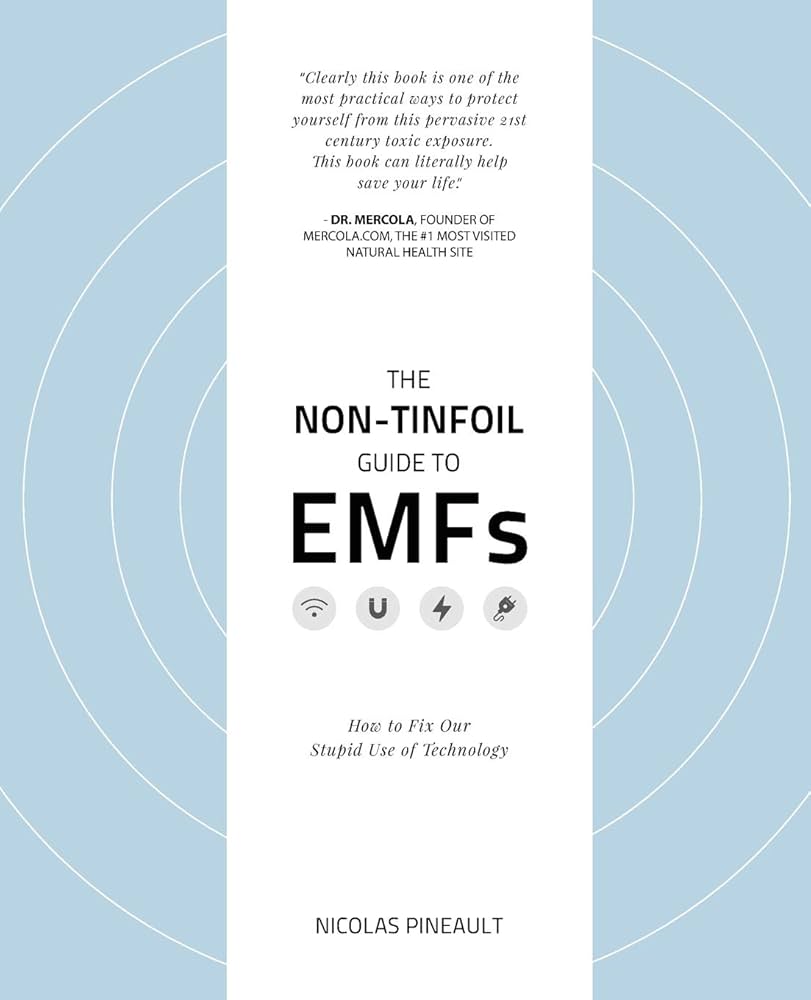
The title is the whole thesis. "Non-Tinfoil" tells you exactly what Nicolas Pineault is trying to do: write the EMF book for the person who already suspects the topic is real but can't stomach the community it tends to attract. The breathless forums, the meter-waving YouTubers, the catastrophist rhetoric about 5G and population control. Pineault walks into that world, takes the best of what's there, and writes it down in a way a reasonable adult can hand to a skeptical friend without embarrassment.
That is a harder task than it sounds, because EMF concern is genuinely split between a reasonable precautionary argument and a sprawling, difficult-to-evaluate fringe. The non-thermal effects of radiofrequency radiation, the central contested claim in EMF research, remain unsettled in mainstream science. Thermal effects are not. Whether EMFs at everyday exposure levels harm biology through non-heating mechanisms is the live question, and the honest answer is that the research is mixed, the studies are methodologically difficult, and the regulatory bodies have moved slowly and defensively.
Pineault's book does not pretend the science is settled. What it does instead is make a precautionary argument: given that uncertainty, and given how easy most of the mitigations are, why not reduce exposure now and wait for the data to mature? That is a coherent position. It is also the book's most durable contribution, regardless of what the non-thermal debate eventually resolves to.
For a detox audience, this is a natural entry point. EMF exposure sits alongside mold, heavy metals, and environmental chemical load as one of the invisible-environment categories that shape health outside most people's awareness. Pineault's book provides the most accessible, least dogmatic starting point for thinking about it.
Who Nicolas Pineault Is
Pineault describes himself as a health journalist and researcher who dug into EMF science after his own health concerns brought him there. He is not a physicist, not a biologist, not an electrical engineer. He is a self-educated writer who spent years reading the primary literature and synthesizing it for a lay audience.
That background matters for how to read the book. His strength is communication and organization. He is good at presenting what the research says and at explaining technical concepts without jargon. His weakness is the same as any self-educated journalist in a contested field: he has no professional standing to evaluate the methodology of the studies he cites, and he is drawn toward the more alarming readings of evidence the way the genre tends to pull writers.
The book reads like the work of someone who genuinely believes the precautionary case and has put in real effort to make it accessible, while working hard to shed the fringe reputation that follows the topic. Whether he fully succeeds on the fringe-shedding depends on the reader's priors, but he succeeds more than most books in this space.
The Core Argument
Pineault builds his case on two separate pillars, and it helps to keep them distinct.
The first is thermal effects. It is established and not seriously contested that radiofrequency radiation at high intensities generates heat in biological tissue, and that heat can damage cells. Regulatory bodies worldwide set exposure standards based on this. Pineault's complaint about thermal-only standards is that they were set with a specific assumption: that any harmful effect must come from heating, so the standard simply limits the heating. If that assumption is wrong, the standard is inadequate.
The second pillar is the contested one. A body of research, some of it methodologically credible, some of it not, suggests that radiofrequency radiation at non-heating intensities, the everyday levels from phones, routers, and smart meters, can produce biological effects. Changes in cell membranes, oxidative stress markers, sleep architecture, and blood-brain barrier permeability have appeared in various studies. The word "can" is doing a lot of work in that sentence. These findings are real in the sense that they have been published, but they are not consistently replicated, and the mechanisms proposed to explain them remain unconfirmed.
Pineault presents this research seriously, and that seriousness is the book's main contribution. He is not inventing the concern. The BioInitiative Report, assembled by a working group of independent scientists, has catalogued thousands of studies raising questions about non-thermal effects. The International EMF Scientist Appeal, signed by hundreds of scientists from dozens of countries, has called for stricter precautionary standards. These are real documents from real people with real credentials. The mainstream scientific and regulatory consensus has not moved to adopt their conclusions, but the dissent is not coming from nowhere.
His argument, stripped down: the research raising concern is credible enough that blanket reassurance is unwarranted, the mitigations are cheap, and the asymmetry favors reducing exposure until the picture clears.
What the Book Actually Covers
The practical half of the book is where it earns its keep. Pineault walks through the major exposure sources in a modern home and gives concrete reduction strategies for each.
Phones. He covers the basic physics: RF radiation drops sharply with distance, so a phone against your head is a categorically different exposure than a phone across the room. Speaker mode, earbuds with wired connections, and keeping the phone out of the bedroom are the foundational recommendations. He addresses the cell tower question and explains why a phone searching for signal is more radiating than a phone with strong reception.
Wi-Fi routers. The router sitting two feet from a work desk is a different exposure than one in another room. He covers router placement, the option of turning it off overnight, and wired ethernet as an alternative. None of this is technically complicated, and most of it requires no new equipment.
Dirty electricity. This is the least well-known section for most readers. Dirty electricity refers to high-frequency voltage fluctuations on the electrical wiring in buildings, produced by switch-mode power supplies, LED dimmer switches, and other modern electronics. Pineault covers the basic argument (that these fluctuations can radiate into the room) and the available mitigation (filters that reduce the fluctuations). The dirty electricity literature is arguably the least established of the three domains he covers, and he is less circumspect here than elsewhere.
Smart meters. He devotes real space to the controversy around smart meters, which transmit usage data wirelessly and have generated organized resistance in some communities. His treatment is fair enough: he presents the concern without catastrophizing it, notes the regulatory position, and gives practical options where they exist.
General exposure hygiene. Distance is the recurring theme. Most of the book's practical advice comes down to increasing the space between your body and the transmitting device. This is not expensive, does not require specialty products, and is the one mitigation that requires no contested science to justify.
Where the Science Is Solid
Pineault is on firmest ground in three areas.
The thermal effects baseline is not in dispute. Regulatory agencies set standards precisely because high RF exposure causes heating and heating damages tissue. The argument about whether those standards are adequate is legitimate. That part of the picture is not invented.
Distance reduces exposure. This is physics, not advocacy. RF radiation falls off with the square of distance. A phone against the ear vs. on speaker across the desk is a real quantitative difference in exposure. Anyone who wants to reduce their RF dose can do so at zero cost simply by keeping devices further from their body, and the magnitude of the reduction is not trivial.
The research body raising concern is real and deserves engagement. Pineault cites the BioInitiative Report and other sources that aggregate non-thermal research. That work exists. The scientists who produced it have credentials. Whether their conclusions are correct is the debate, but Pineault is not fabricating a controversy that isn't there.
Where It Gets Contested
The honest assessment of "The Non-Tinfoil Guide to EMFs" has to name what the book reaches past.
The non-thermal effects it describes have not been established as causal at everyday exposure levels. The studies Pineault draws on are real, but they are not the entire picture. Research in this field is methodologically messy: exposure levels vary across studies, biological endpoints vary, replication rates are uneven, and the funding sources on both sides introduce bias in both directions. The mainstream regulatory position is not simply industry capture, even if regulatory agencies have sometimes been slow or defensive. The research is genuinely inconclusive.
Dirty electricity is the section where skepticism should sit highest. The mechanism proposed, that high-frequency fluctuations on wiring radiate into rooms and affect biology, is the least supported claim in the book. The studies referenced are fewer and the methodological quality is more variable. Pineault's enthusiasm here outpaces his caution.
The book's tone occasionally drifts toward the alarming end of the available readings. He tends to present the evidence for concern without giving equal weight to the null findings and the replication failures. A reader who wants to understand the state of non-thermal EMF science will need to supplement this book with the scientific literature itself.
The precautionary principle, which he invokes throughout, is a legitimate framework. But it is not evidence of harm. It is a policy stance about how to act under uncertainty. The book sometimes blurs that distinction, presenting precautionary advice in a way that implies the concern is more settled than it is.
None of this means the book's practical advice is wrong. Some of it is almost certainly right, and virtually all of it is harmless. Keeping a phone off the bed stand costs nothing. Wired ethernet is faster than wifi anyway. Turning a router off at night is a two-second habit. The cost-benefit of the mitigations does not depend on the non-thermal science being resolved. That remains the book's cleanest argument.
How This Fits a Real Detox Practice
EMF exposure sits in a broader context for anyone taking environmental health seriously. The logic is the same across categories: the body runs on subtle electrical signaling, modern environments add inputs that didn't exist during human evolution, and load reduction across all categories matters more than hunting down any single culprit.
For someone already working through grounding and earthing protocols, this book is a natural pairing. Grounding reconnects the body to the earth's natural electrical state, and reducing synthetic EMF exposure is the complementary move: less artificial input, more natural baseline.
The digital environment question connects directly. Someone doing a digital and blue light detox is already thinking about how device habits affect sleep architecture, cortisol timing, and neurological recovery. Adding EMF hygiene to that practice, particularly around the bedroom, extends the same logic into the RF domain.
For practical tools and specific meters for measuring your own exposure before and after mitigations, the EMF protection tools guide is the best companion resource to this book. And for a broader survey of what EMF science actually says and what protective strategies have the best evidence base, the EMF radiation protection guide goes deeper than Pineault's introduction.
The book functions best as a primer and motivator for someone who has heard about EMF health concerns but has not yet done anything about them. It gives you enough to take the first steps without requiring you to become an expert first.
Who Should Read It
Read it if:
- You are new to EMF health concerns and want a readable, non-catastrophist introduction
- You want practical steps you can take immediately at low cost or no cost
- You find the precautionary argument compelling and want to understand its logic
- You are already thinking about environmental health holistically and want EMF included
Read it carefully, or supplement it, if:
- You want a rigorous evaluation of the non-thermal science. This book tilts toward the concerning readings and would need to be balanced against mainstream summaries
- You are particularly interested in dirty electricity specifically. The evidence base there is thinner than Pineault's treatment suggests
- You want to know exactly how much risk reduction each mitigation achieves. The book is not quantitative in that way
This book is not a substitute for:
A careful reading of the primary literature if you want to form a fully informed view. The EMF science debate is live, the meta-analyses are mixed, and the regulatory bodies are genuinely uncertain, not simply captured. Pineault gives you the precautionary camp's best argument, but the precautionary camp is not the only serious voice in the room.
The Bottom Line
"The Non-Tinfoil Guide to EMFs" delivers on its title. It presents the case for EMF precaution accessibly, without the catastrophism that makes most writing on the topic difficult to share. The practical advice is reasonable, often free, and does not require the non-thermal science to be resolved before acting on it.
The book's honest limits are in its framing. Pineault cares about the precautionary case, and that care shapes what evidence he foregrounds. The contested non-thermal effects he describes are real areas of scientific inquiry, not fabricated concerns, but they are not established harms. A reader who finishes this book thinking the science definitively proves that everyday EMF exposure damages biology has read more certainty into it than the evidence holds.
For a detox practice, the argument is simple. You are already reducing exposure to things you cannot see, cannot smell, and cannot feel: mold spores, heavy metals, endocrine disruptors. Adding RF hygiene to that list, through steps that cost nothing, is consistent with the same logic. Pineault makes that case well enough. Read it as a starting point, check the EMF radiation protection guide for a fuller evidence review, and calibrate your investment in mitigation to your own tolerance for uncertainty.
The title promised a guide for people who are not crazy. For the most part, it delivers one.
Related MadWorldDetox Guides
- EMF Radiation Protection Guide - A broader evidence review and protection strategy beyond this book's introduction
- EMF Protection Tools - Meters, filters, and shielding with honest assessments of what works
- Grounding and Earthing Detox Guide - The complementary practice: reconnecting to the earth's natural electrical baseline
- Digital Dopamine and Blue Light Detox - Extending device hygiene into the sleep and neurological domain
Products Mentioned
The Book:
The Non-Tinfoil Guide to EMFs - Nicolas Pineault, accessible practical guide to EMF reduction covering phones, wifi, dirty electricity, and smart meters.
Affiliate Disclosure: This review contains affiliate links. We may earn a small commission on purchases made through these links at no additional cost to you. We only recommend books and products we've researched and believe provide value. Our assessment of the book itself is independent of any affiliate relationship.
Last updated: June 2026