Book Review: Gut: The Inside Story of Our Body's Most Underrated Organ by Giulia Enders
Last updated: June 2026 Reading time: 12 minutes
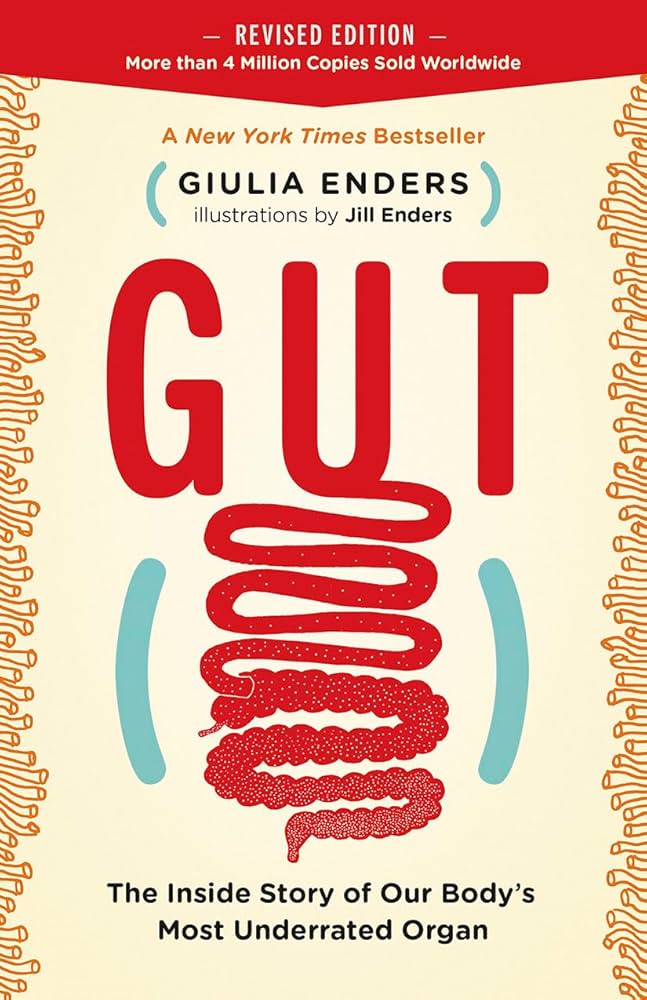
Most people know almost nothing about how their gut actually works. They know it digests food. They know it sometimes hurts. Beyond that, the territory is a blank. Giulia Enders wrote a book specifically for that person, and it became an international bestseller, translated into more than forty languages.
"Gut" is not a detox protocol. It is not a functional medicine manual. It is a popular-science tour through the digestive system, written by a gastroenterologist in language that treats the reader as curious rather than expert. Enders covers how food moves through the body, how the gut communicates with the brain, what the microbiome actually is, and why none of this has received the attention it deserves. The tone is warm and sometimes playful, which suits the subject (there are passages on defecation posture and gut acoustics that you will not find in most medical texts), but it does not sacrifice accuracy for friendliness.
For the MadWorldDetox reader, the book matters as a foundation. Before you can understand what a gut detox is trying to accomplish, you need to know how the system works under normal conditions. Enders gives you that picture clearly, and the picture is interesting enough to make you take gut work more seriously, not less.
This review covers what Enders gets right, where she simplifies in ways that matter, and how the book fits alongside more protocol-focused resources.
Who Is Giulia Enders?
Giulia Enders is a German physician and gastroenterologist who wrote this book while still a medical student, based on a combination of her academic studies and a personal history with gut illness. She won a science communication award in Germany for a stage presentation of the same material, and the book grew from that talk.
Her credentials are not those of a research scientist running clinical trials, and it is worth being clear about that. She is a trained doctor explaining an established field of science to a general audience. The book reflects the consensus of gastroenterology and microbiology research as it stood at the time of writing, presented for people without a biology background.
That framing is important: Enders is not making original scientific claims. She is translating a body of research into plain language. This is both the book's strength and the source of its main limitation, which we will cover below.
The Core Thesis: Your Gut Is Running More of Your Life Than You Think
Enders' central argument is that the digestive system is systematically underestimated. We think of it as a tube that processes food. She makes the case that it is substantially more than that.
Three threads run through the book:
The gut has its own nervous system. The enteric nervous system contains hundreds of millions of nerve cells, more than the spinal cord. It operates largely independently of the brain, governing the complex muscular contractions that move food through roughly nine meters of digestive tract. Enders calls this the "second brain," a phrase now common in gut-health writing, and explains in accessible terms how it coordinates an operation too complicated to run on instructions from the brain above.
The gut and brain are in constant conversation. Most people learn the vagus nerve exists when they encounter gut-brain research. Enders explains the physical cable clearly: a nerve running from the brainstem down into the gut and organs, carrying signals in both directions. She covers how gut bacteria influence this signaling, how emotional states affect digestion and vice versa, and why the gut-brain connection is real communication rather than metaphor.
The microbiome is an ecosystem, not a collection of disease agents. The trillions of bacteria living in the gut include species that produce vitamins, regulate immune function, ferment fiber into compounds the gut lining uses as fuel, and compete with harmful organisms for space. Enders explains how this ecosystem forms from birth, what disrupts it, and what a diverse, well-fed microbiome looks like versus a depleted one.
These three arguments build on each other. By the time Enders has laid the groundwork, the gut stops looking like a passive pipe and starts looking like a major organ system with significant influence on how you think, feel, and respond to the world. That reframe is the book's real contribution.
What the Book Actually Covers
The structure moves through the digestive system roughly in order: how food enters, how it is processed, where absorption happens, and how waste is handled. Alongside the anatomy, Enders weaves in the microbiome, the immune connection, and the gut-brain axis.
On digestion mechanics, she is excellent. The section on peristalsis (the muscular wave contractions that move food through the gut) explains a process most people have never visualized. Her account of the two sphincters of the anus and why they require coordination from both the voluntary and involuntary nervous systems is oddly riveting. She takes the basic anatomy of digestion seriously rather than skipping it in favor of the trendier microbiome content.
On the microbiome, she covers:
- How the gut flora is established in infancy, through birth canal passage, breastfeeding, and early environmental exposure
- What antibiotics do to microbial diversity and why recovery is not automatic (a theme that also runs through our detox after antibiotics guide)
- The role of fiber as fuel for beneficial bacteria and why a low-fiber diet starves the ecosystem
- The evidence for fermented foods and how live cultures differ from dead ones in commercial products
- The connection between gut flora and immune training, given that a large portion of immune tissue is concentrated around the digestive tract
The gut-brain material is handled carefully. Enders explains the vagus nerve, serotonin production in the gut (with appropriate caveats that gut serotonin does not simply travel to the brain), and the research showing that germ-free animals develop differently than animals with a normal microbiome. She draws on much of the same research base as "The Psychobiotic Revolution," though she covers it at greater breadth and less depth. The two books are genuinely complementary, and if you have read the Psychobiotic Revolution first, Enders fills in the anatomical picture that book leaves relatively thin.
Where the Science Is Solid
Enders is accurate on the structural biology. The anatomy she describes is uncontested: the enteric nervous system, the layout of the gut, the role of the villi and microvilli in absorption, the sphincter mechanics. This is not speculative science; it is the foundation of gastroenterology, and she explains it well.
The microbiome diversity argument holds up. The case for dietary fiber as the primary fuel for a healthy gut flora is among the most replicated findings in nutritional science. Enders does not overstate the evidence here; she presents a strong and well-supported relationship between fiber intake, microbial diversity, and gut health outcomes.
Her account of antibiotic effects is accurate. Broad-spectrum antibiotics do flatten gut flora diversity, and recovery takes time. This is documented in human studies. The implication for anyone who has been through repeated antibiotic courses is real: rebuilding is active work, not a passive return to normal.
The immune-gut connection is well established. Roughly seventy percent of immune tissue sits around the digestive tract, and the microbiome plays a documented role in immune training from infancy onward. Enders explains this in accessible terms without exaggerating the causal direction.
She is also honest about the nascent state of microbiome research at the time of writing. Much of what was understood about the microbiome's influence on health was emerging research, and she acknowledges uncertainty where it exists rather than treating association as proof.
Where Enders Simplifies (and Why That Matters)
The book's accessible tone is earned and mostly serves the reader. But some of the simplifications deserve attention, because they affect how you interpret what you read.
The strain-specificity problem. Enders discusses probiotics with enthusiasm, and the case for fermented foods and diverse fiber is solid. But in places, the discussion of specific probiotic strains implies more clinical certainty than exists. The research on which specific strains produce which specific health effects is considerably more mixed than a lay reader of this book might conclude. A probiotic that helped in one study at one dose, in people with one condition, does not straightforwardly predict what the bottle on the shelf will do for you. This gap between "the microbiome matters enormously" and "this specific supplement will fix this specific problem" is where marketing has run far ahead of science, and Enders' accessible framing can inadvertently bridge that gap faster than the evidence warrants. The Psychobiotic Revolution review addresses this problem in more depth, and the two reviews read well together.
The causal direction question. Enders presents research showing that gut flora is different in people with various conditions, including depression and obesity. The direction of causality in many of these associations is genuinely unresolved: does the disrupted microbiome contribute to the condition, or does the condition (through stress, altered eating, medication, disrupted sleep) reshape the microbiome? Enders leans toward the more interesting causal reading in ways the evidence does not always support, which is a common pattern in gut-health writing and one worth keeping in mind.
The scope of the second-brain claim. The "second brain" label is evocative and justified in the narrow sense that the enteric nervous system is remarkably autonomous. But in popular coverage, this framing sometimes slides toward implying the gut has decision-making authority similar to the brain above. Enders is careful about this; she does not make that slide. But readers who encounter the phrase elsewhere should note that "second brain" is a structural description of neural density and autonomy, not a claim that the gut thinks.
None of these caveats undermine the book's value. They are worth naming because detox readers sometimes encounter the book in a context where simplification gets amplified further, and arriving with accurate expectations prevents misreading.
How This Fits a Real Detox Practice
"Gut" is not a protocol book, but it gives a gut-detox practice something valuable: a clear picture of what you are trying to restore.
Diversity is the organizing goal. Enders makes this plain. A depleted microbiome is one that has lost species, lost functional redundancy, lost the ecosystem's ability to handle disruption. Everything in a gut detox worth doing points toward recovering that diversity. The gut detox complete guide covers the practical steps; Enders gives you the reason they matter.
Antibiotics warrant a real response. The book is clear that a course of antibiotics can fundamentally alter the gut flora, and that the alteration does not automatically reverse. Anyone carrying a history of repeated antibiotic use, whether for Lyme, infections, or anything else, should read Enders' account of this and then move to the detox after antibiotics guide for the practical recovery framework.
What you eat is what your microbiome eats. Fiber, fermented foods, and dietary diversity are not wellness trends in Enders' framing. They are the inputs that determine what species survive in the gut. This is the foundation of any real gut-restoration effort, and it is where the elimination diet detox guide intersects: clearing foods that feed disruption while building the fiber and fermented-food base that beneficial species need.
Gut health extends beyond digestion. Enders helps a reader understand why gut work shows up in mood, immune function, and symptom patterns that seem unrelated to digestion. This framing supports the broader MadWorldDetox argument: the gut is often where chronic illness starts, and it is often where recovery has to start too.
For readers who want to go further into the gut-brain connection and the psychological dimensions of microbiome disruption, the Psychobiotic Revolution review pairs naturally here, covering the mood-and-craving implications in depth that Enders' book doesn't prioritize.
Who Should Read It
Read it if:
- You want to understand how the gut actually works before diving into protocols and cleanses
- You find dense scientific texts off-putting and need an entry point that is genuinely readable
- You are working on gut health and want the mechanistic grounding to make protocol decisions feel less arbitrary
- You want a book that takes the gut seriously as a system, written by someone who does it without overselling
Read it carefully if:
- You are prone to reading probiotic supplement marketing through the lens of legitimate science. The book is accurate; the marketing that uses the same vocabulary often is not
- You are looking for specific clinical guidance or dosing protocols. This is not that book
Skip it, or start with something else, if:
- You already have a solid understanding of gut biology and the microbiome and are looking for actionable protocols. Move directly to the gut detox complete guide or the elimination diet detox guide
The Bottom Line
"Gut" is one of the better science communication books in the health space. Enders knows the biology, translates it faithfully, and writes with enough personality to make the subject engaging rather than clinical. The book's portrait of the digestive system as an underestimated organ running sophisticated operations is accurate and, for most readers, genuinely new.
The book will not give you a protocol. It will not tell you what to take or in what order. What it gives you is a model: a way of understanding what a healthy gut is doing, what a disrupted gut is missing, and why the choices you make about food, antibiotics, and stress have consequences that extend well past digestion.
For a detox practice, that model is worth having. It is the difference between following steps because someone said they work and following steps because you understand what they are trying to achieve. Enders does not write about detox specifically, but the system she describes is exactly the one a good gut protocol is trying to restore.
It is an honest, accessible book that earns its popularity. Read it as the foundation it is, then pair it with the more specific resources your situation calls for.
Related MadWorldDetox Guides
- Gut Detox Complete Guide - Rebuilding microbial diversity with a practical, step-by-step protocol
- The Psychobiotic Revolution: Book Review - The gut-brain science in depth, by the researchers who built the field
- Detox After Antibiotics Guide - Restoring the flora a course of antibiotics disrupts
- Elimination Diet Detox Guide - Clearing the dietary inputs that destabilize the gut ecosystem
Products Mentioned
The Book:
Gut: The Inside Story of Our Body's Most Underrated Organ - Giulia Enders, MD. Accessible, science-grounded microbiome primer from a gastroenterologist; the best entry-level gut book in print.
Affiliate Disclosure: This review contains affiliate links. We may earn a small commission on purchases made through these links at no additional cost to you. We only recommend books and products we've researched and believe provide value. Our assessment of the book itself is independent of any affiliate relationship.
Last updated: June 2026