Book Review: The Psychobiotic Revolution by Scott C. Anderson, John F. Cryan & Ted Dinan
Last updated: June 2026
Reading time: 14 minutes
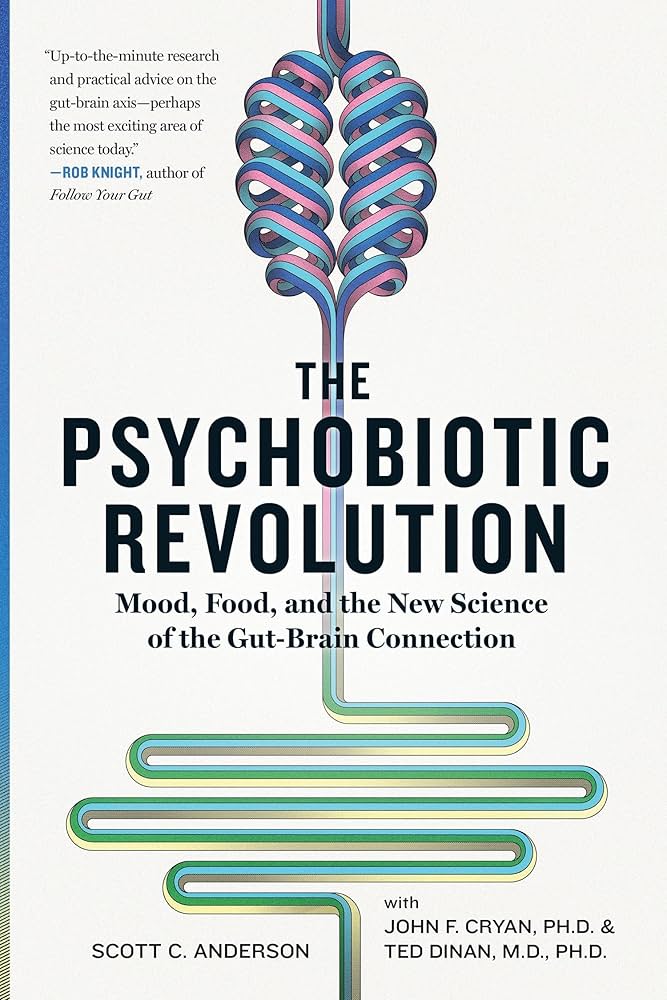
Most detox books ask you to clean out your liver, your colon, your blood. This one makes a stranger argument: that the thing most worth cleaning out might be quietly running your moods, your cravings, and a fair share of your decisions, and you've never once thought of it as yours to manage.
That thing is your gut microbiome. The trillions of bacteria living in your intestines.
"The Psychobiotic Revolution" is the popular-science account of an idea that sounded fringe twenty years ago and now anchors thousands of peer-reviewed papers: the bugs in your gut talk to your brain, and your brain listens. The book is written by science journalist Scott C. Anderson alongside two of the researchers who built the field, John F. Cryan and Ted Dinan of the APC Microbiome Institute at University College Cork. Cryan and Dinan coined the word "psychobiotic" in 2013, defining it as a live organism that, taken in adequate amounts, produces a mental-health benefit.
For a detox audience, this book matters for one reason. It moves the gut from a digestion story to a whole-person story. What you eat, the antibiotics you've taken, the glyphosate on your food, the parasites in your tract, the stress you carry: these don't just upset your stomach. They reshape the microbial community that helps regulate your nervous system. Clean the gut, and you may be cleaning more than you think.
This review covers what the book gets right, where it stretches, and how to read it without falling for the hype that now surrounds anything with "microbiome" on the label.
What the Book Actually Argues
The core claim is the gut-brain axis: a two-way communication line between your digestive tract and your central nervous system. Anderson, Cryan, and Dinan walk through the hardware of that line in plain language.
The vagus nerve. A physical cable running from gut to brainstem. Cut it in animal studies, and many of the behavioral effects of gut bacteria vanish. This is the express lane for microbial signals reaching the brain.
Neurotransmitter production. Gut bacteria manufacture or trigger the production of the same chemicals your brain uses to regulate mood. A large share of the body's serotonin is produced in the gut. Certain bacterial strains influence GABA, dopamine, and other signaling molecules. The book is careful here, and you should be too: serotonin made in the gut does not simply float up to the brain. The influence is more indirect, through nerves, immune signaling, and metabolites. But the production is real.
The immune system. Roughly seventy percent of your immune tissue sits around your gut. Microbes train it. When the microbial community is disrupted, low-grade inflammation can follow, and inflammation is now tightly linked to depression and anxiety in the research literature.
Short-chain fatty acids and metabolites. When gut bacteria ferment fiber, they produce compounds like butyrate that nourish the gut lining and send signals systemically. A diverse, well-fed microbiome produces a different chemical output than a starved, monoculture one.
From this hardware, the authors build their headline idea. The state of your gut flora is not a side effect of your mental health. In many cases it is an input.
The Part That Will Stay With You: Microbes and Cravings
The book's most provocative thread is the one a detox reader should sit with longest.
Your microbes have skin in the game of what you eat. They are living organisms competing for resources, and the resource is the food passing through your gut. Bacteria that thrive on sugar do better when you eat sugar. So the question the authors raise, drawing on real animal and human research, is uncomfortable: when you crave something, whose craving is it?
The mechanism is plausible and partly demonstrated. Gut microbes can influence the vagus nerve, manipulate reward and satiety signaling, and produce molecules that affect appetite. In animal studies, transferring gut bacteria from one animal to another can transfer aspects of behavior and food preference along with it. The picture that emerges is of a microbial population with a stake in your choices, capable of nudging the host toward the foods that feed it.
The honest version of this, which the book mostly holds to, is not that little puppet-masters control your mind. It's that the line between "my preference" and "my microbes' preference" is blurrier than anyone assumed, and that a craving is not always a clean signal from your true self. For anyone who has tried to break a sugar habit and felt the pull as something almost external, that reframe lands.
This is where the detox relevance becomes concrete. If a disrupted microbiome can bias your appetite toward the very foods that keep it disrupted, then resetting the gut is not only a digestive project. It's a way of taking back the controls.
Where the Science Is Solid
Give the book credit for restraint that most wellness writing abandons.
The animal evidence is strong. Germ-free mice, raised with no microbiome at all, show altered stress responses, anxiety-like behavior, and brain development differences. Give them a normal microbiome early enough and much of it normalizes. Transfer the microbiome of a depressed human into a rodent and the rodent takes on depression-like behavior. These are striking, replicated findings, and the authors present them accurately.
The human associations are real. People with depression, anxiety, and several other conditions tend to have measurably different gut flora than healthy controls. The correlation is well documented.
The fiber-and-fermentation story holds up. The advice to feed your microbiome a diverse range of plant fibers, and to include fermented foods, rests on solid ground. This is the least controversial and most actionable part of the book.
The authors flag their own limits. Repeatedly, Anderson, Cryan, and Dinan note that human intervention trials are early, that associations are not proof of cause, and that the field is young. That intellectual honesty is rare in this genre and worth rewarding.
Where It Stretches
A balanced read has to name the gaps, because the marketplace built on top of this science routinely ignores them.
Mice are not people. The most dramatic results come from rodents, often germ-free rodents that don't exist in nature. The leap from "this changes mouse behavior" to "this will change your depression" is exactly the leap the research has not yet earned. The book knows this. Readers excited by the book often forget it.
Correlation keeps getting dressed as causation. Depressed people have different gut flora. Does the flora cause the depression, or does depression (through diet, stress, sleep, and cortisol) reshape the flora? Both directions are live. The book leans toward the more exciting reading more often than the evidence strictly allows.
"Psychobiotic" is a promise, not a product category yet. The idea that specific probiotic strains can reliably treat specific mental-health conditions is the book's namesake hope. Human trials remain small, mixed, and strain-specific. A probiotic that helped in one study at one dose says little about the bottle on the shelf. Anyone reading this book as a buying guide for mood-fixing supplements is reading it wrong.
The supplement industry has run far ahead of the data. This isn't the authors' fault, but it's the reader's problem. "Microbiome" is now a marketing word. The science in this book is being used to sell things the science does not support.
How This Fits a Real Detox Practice
Strip the book to what's usable for someone actually working on their gut, and a clear shortlist remains.
Diversity is the goal, not a single magic strain. A wide range of plant fibers feeds a wide range of beneficial bacteria. This is the throughline of the book and the foundation of any gut-focused protocol. Our gut detox complete guide covers how to rebuild that diversity step by step.
Antibiotics carry a hidden cost. The book is clear-eyed about how a course of antibiotics can flatten microbial diversity for months. If you've been through repeated rounds, rebuilding is not automatic. The detox after antibiotics guide addresses this directly.
Parasites and dysbiosis change the whole picture. The book focuses on bacteria, but the same logic applies to a gut hosting unwanted organisms. A disrupted microbial environment is one that's easier for opportunists to colonize, and harder to think clearly inside of. This is where the gut-brain story overlaps with parasite work like the full moon parasite cleanse protocol.
Fermented foods earn their place. The recommendation to include live fermented foods is among the best-supported in the book and one of the cheapest interventions available.
What feeds the gut quietly feeds the mind. This is the book's real gift to a detox practice. It gives you a reason to take gut work seriously that goes beyond digestion. The payoff may show up as steadier mood, fewer cravings, and clearer thinking.
For anyone wanting to put the principles into practice through diet, the elimination diet detox guide pairs naturally with this book's central message.
Who Should Read It
Read it if:
- You want the gut-brain science explained well, by people who actually built the field, without a textbook's density
- You're working on cravings or mood and want to understand the biological reasons gut work might help
- You appreciate authors who tell you the limits of their own evidence
- You want a foundation that makes the rest of detox practice make more sense
Skip it, or read it carefully, if:
- You want a step-by-step protocol. This is a science book, not a manual
- You're looking for a supplement to buy. The book doesn't deliver that, and anyone selling you "psychobiotics" off the back of it is ahead of the data
- You're prone to treating exciting science as settled fact. This field is young, and the book's enthusiasm can read as more certain than the evidence is
The Bottom Line
"The Psychobiotic Revolution" is the rare wellness-adjacent book written by the actual scientists, and it shows. The mechanisms are explained with care, the limits are flagged honestly, and the central insight is genuinely worth carrying: the community of organisms in your gut is not a passive passenger. It participates in how you feel and what you want.
The book overreaches in one predictable direction, toward the hope that specific strains will soon treat specific mental-health conditions. That hope may pay off. It hasn't yet. Read the science as a strong, well-told case for taking your gut seriously, and ignore the supplement marketing that has since wrapped itself around these ideas.
For a detox practice, the takeaway is simple and grounding. When you rebuild your gut, you are not only repairing digestion. You may be quietly reclaiming a say in your own moods and cravings that you didn't know you'd given away.
Related MadWorldDetox Guides
- Gut Detox Complete Guide — Rebuilding microbial diversity from the ground up
- Detox After Antibiotics Guide — Restoring the flora a course of antibiotics flattens
- Elimination Diet Detox Guide — Putting the fiber-and-diversity principle into practice
- Full Moon Parasite Cleanse Protocol — When the gut hosts more than bacteria
- Best Binders for Detox — Capturing what's released during gut work
- Water Fasting Complete Guide — Resetting the gut through fasting
Products Mentioned
The Book:
The Psychobiotic Revolution: Mood, Food, and the New Science of the Gut-Brain Connection — Scott C. Anderson with John F. Cryan, Ph.D. & Ted Dinan, M.D., Ph.D. National Geographic, 2017. 320 pages. ISBN 9781426218460.
Affiliate Disclosure: This review contains affiliate links. We may earn a small commission on purchases made through these links at no additional cost to you. We only recommend books and products we've researched and believe provide value. Our assessment of the book itself is independent of any affiliate relationship.
Last updated: June 2026