Heavy Metals in Food: What Lab Testing Actually Found, and What the Panic Gets Wrong
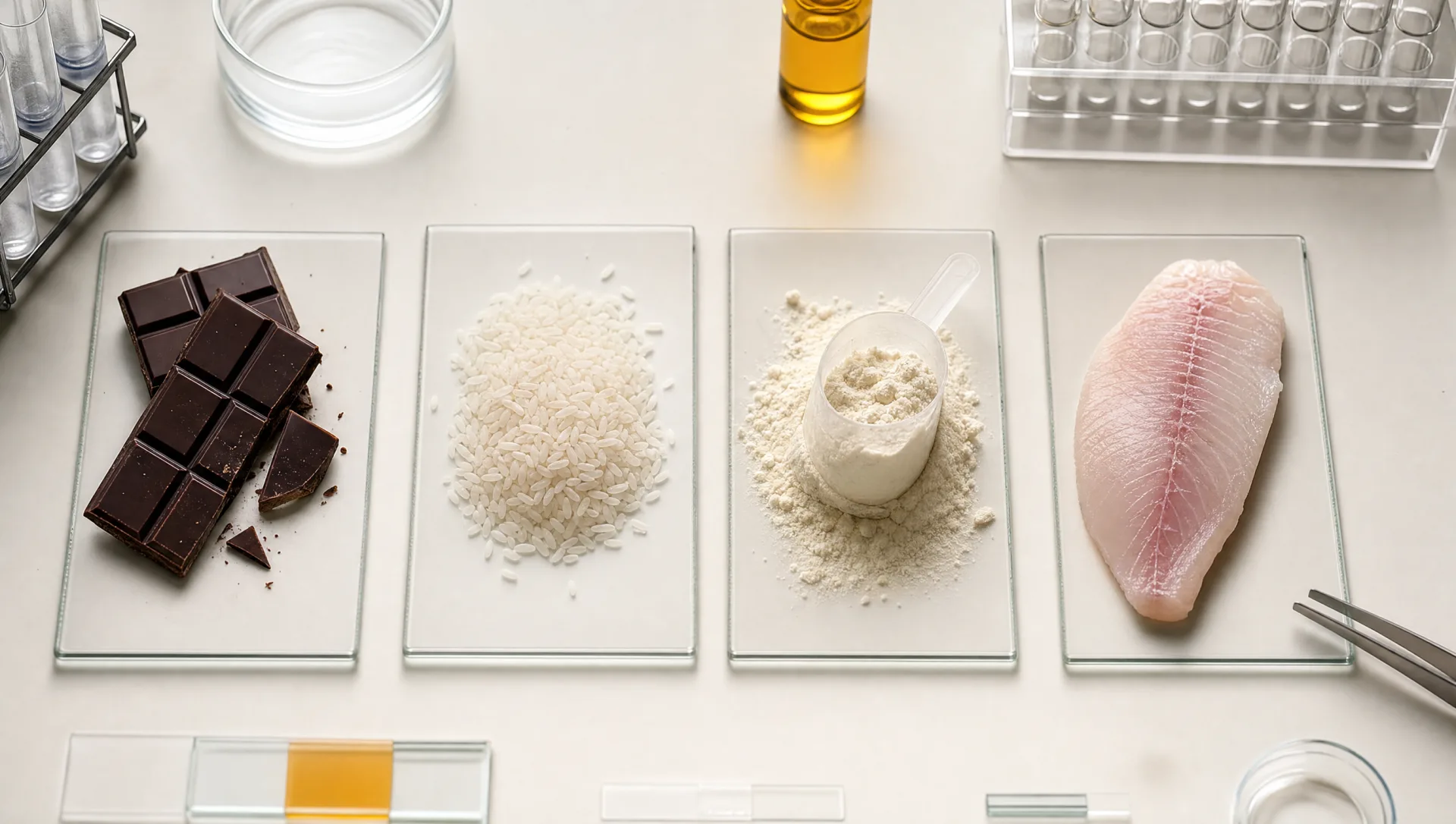
Lead, cadmium, arsenic, and mercury show up in a lot of everyday food, and the testing that proves it is public. We pulled the actual numbers from FDA monitoring, Consumer Reports, the Clean Label Project, a Congressional investigation, and peer-reviewed labs. The metals are real. The alarm is often measured against a benchmark most people have never heard of.
Last updated: July 2026 · Sources: FDA, CDC, WHO, Consumer Reports, Clean Label Project, As You Sow, 3 peer-reviewed studies
Quick verdict: Independent testing keeps finding lead and cadmium in dark chocolate, lead in protein powder, and arsenic in rice and baby food. Those findings are genuine and worth acting on, especially for pregnant women and small children, where the science is unambiguous. But most of the scary percentages are measured against California's Prop 65 limits, which are the strictest numbers in the world and far below federal action levels. The honest read: a few specific swaps cut most of your exposure, and panic across your whole diet is not supported by the dose math.
How to Read Any Heavy-Metal Headline
Almost every "X% of products are dangerous" story rests on one number: California's Maximum Allowable Dose Level, or MADL, under Prop 65. For lead it is 0.5 micrograms per day. For cadmium it is 4.1 micrograms per day.[1] These are deliberately conservative reproductive-toxicity thresholds, set with large safety margins, and they are not federal limits. The FDA's own interim reference level for lead is 8.8 micrograms per day for adults, roughly 17 times higher than the Prop 65 number.[6]
So when a study says a chocolate bar hits "265% of the limit," it means 265% of the strictest benchmark that exists, not 265% of a level where anyone has documented harm. Hold that context through everything below. It is the difference between journalism and fear farming.
One thing the strict-benchmark caveat does not soften: lead. The CDC's position is blunt. "No safe blood lead level in children exists."[2] The WHO says the same, that there is "no level of exposure to lead that is known to be without harmful effects," and attributes more than 3.5 million deaths worldwide to lead in 2023.[3] For adults eating a varied diet, small amounts are a manageable risk. For a developing brain, less is always better.
Dark Chocolate: The Cleanest Data, the Biggest Gap Between Panic and Dose
Dark chocolate is the most-tested food in this space, and the results are consistent. In Consumer Reports' 2022 investigation, 23 of 28 dark chocolate bars carried enough lead or cadmium that eating one ounce a day would push an adult past CR's level of concern for at least one metal. Five bars were over for both.[4] Hershey's Special Dark came in highest for lead at 265% of the MADL.
The independent numbers are larger. As You Sow, the group whose lab testing drove Prop 65 legal notices against more than 20 brands, found 285 of 469 chocolate products above California's limits for lead and/or cadmium.[5]
Now the other half of the truth, which most coverage buries. The one peer-reviewed study here, an eight-year analysis of 72 dark chocolate and cocoa products published in Frontiers in Nutrition in 2024, found that while 43% of products exceeded the Prop 65 lead threshold per serving, 97.2% fell below the FDA's interim reference levels.[6] Both facts are real. Which one you lead with is an editorial choice, and most outlets chose the scarier one.
The mechanism explains why chocolate is hard to fix: cadmium is drawn up from soil by the cacao plant itself, and lead settles onto the beans after harvest, during outdoor sun-drying.[4] It is a farming and processing problem, not an additive you can strip out.
Read next: The Heavy Metal Detox Protocol — the drainage-first approach before any binder.
Protein Powder: Plant-Based Is the Real Signal
Two 2025 datasets landed on the same core finding from opposite methods. Consumer Reports tested protein powders and shakes and reported that about 70% exceeded 120% of its daily lead concern level, and that plant-based products averaged nine times the lead of dairy and whey ones.[7] The worst single product, Naked Nutrition's Vegan Mass Gainer, carried 7.7 micrograms of lead per serving. One Huel plant-based powder delivered 9.2 micrograms of cadmium in a serving, more than double the 4.1-microgram daily figure.
The Clean Label Project, testing 160 products, found 47% exceeded at least one federal or state limit, with plant-based powders showing five times the cadmium of whey and organic products averaging three times the lead of non-organic.[8] The pattern is the same across both: plant protein pulls metals out of soil, and "organic" does nothing to stop it. If anything, it correlates with more.
Then the counterweight, because discernment cuts both ways. A 2020 peer-reviewed risk assessment in Toxicology Reports reanalyzed the same Consumer Reports and Clean Label Project data and concluded the metal levels "do not pose an increased health risk" at typical intake, with a Hazard Index below 1.[9] Mass gainers scored highest; whey scored lowest. The metals are present and plant powders are the standout. Whether that clears a real harm threshold at one scoop a day is genuinely contested, and the Prop 65 benchmark is doing most of the alarming work.
One caution on a viral claim: the Clean Label Project reported chocolate-flavored powders holding 110 times the cadmium of vanilla. Consumer Reports tested for the same thing and found no meaningful flavor difference. Treat the 110x figure as one lab's finding, not settled fact.
Rice and Baby Food: Where the Concern Is Real
This is the category where the strict-benchmark caveat stops applying, because the exposed population is infants. The 2019 Healthy Babies Bright Futures study tested 168 baby foods and found 95% contained at least one toxic metal, one in four contained all four, and 87% contained more than one.[10]
The 2021 Congressional investigation that followed used the baby-food companies' own internal testing. Products from Nurture's HappyBABY line tested as high as 180 ppb inorganic arsenic and 641 ppb lead; Hain used a brown rice flour ingredient measuring 309 ppb arsenic.[11] Three of the seven companies asked, including Walmart and Campbell, refused to hand over data, so the report warned the real picture may be worse.
Rice is the engine here, and it carries a genuinely counterintuitive lesson. Brown rice, the reflexive "health" choice, holds about 154 ppb inorganic arsenic against white rice's 92 ppb, because arsenic concentrates in the bran layer that milling removes.[12] For a toddler eating rice cereal daily, white rice is the lower-arsenic option, and rinsing plus cooking in excess water lowers it further.
The regulators are, slowly, catching up. The FDA finalized a 100 ppb inorganic arsenic action level for infant rice cereal in 2020, and in January 2025 set its first lead limits for baby food: 10 ppb for most purees, 20 ppb for dry cereals.[13]
Read next: Best Binders for Heavy Metal Detox and Chlorella, Reviewed.
Fish: A 330-Fold Spread You Control by Species
Mercury in seafood is the best-quantified item on this whole list, because the FDA publishes mean concentrations per species. The range is enormous. Swordfish averages 0.995 ppm mercury and shark 0.979; scallops sit at 0.003 ppm, salmon at 0.022, sardines at 0.013, shrimp at 0.009.[14] That is a roughly 330-fold spread across the same fish counter.
The practical takeaway writes itself. The FDA and EPA put king mackerel, shark, swordfish, marlin, orange roughy, bigeye tuna, and Gulf tilefish on the "avoid" list, and salmon, sardines, shrimp, and scallops among the best choices.[15] Canned light tuna (0.126 ppm) carries roughly a third the mercury of canned albacore (0.350 ppm), which is the single easiest swap in the aisle.
What Actually Reduces Your Load
Strip out the panic and the data points to a short, unglamorous list:
- Rice: choose white over brown for daily eaters, rinse it, and cook in extra water you pour off. Vary grains so rice is not every meal.
- Fish: eat from the low-mercury list, keep the high-mercury predators occasional, and switch canned albacore to light tuna.
- Protein powder: whey and dairy test far lower than plant and organic. If you use plant protein daily, rotate brands and treat the metal load as real.
- Chocolate: a square of dark chocolate is not the problem; a daily quarter-bar of the highest-cadmium 85% bars is where the dose adds up. Milk chocolate and lower-percentage bars carry less.
- Babies and pregnancy: this is the one group where the strict benchmarks are the right benchmarks. Minimize infant rice cereal, skip the "avoid" fish entirely, and favor the FDA-tested brands.
The foundation underneath all of it is the same one this site keeps returning to: a body with open drainage and good mineral status clears everyday metal load on its own. Supporting that comes before any binder or chelation protocol, and filtered drinking water removes an exposure route this article did not even cover.
Bottom Line
The testing is legitimate and you should act on the specific, high-signal items: infant rice, plant protein eaten daily, high-mercury fish, the heaviest dark chocolate. The blanket dread is not supported, because most of the alarming percentages are measured against the strictest benchmark on earth, and the peer-reviewed risk math often lands below a real harm threshold. Lead is the exception that keeps everyone honest, since no amount is provably safe. Fix the four or five things that matter, support your body's own clearance, and stop performing anxiety about a square of chocolate.
FAQ
What foods have the most heavy metals?
By published testing, the standouts are dark chocolate (lead and cadmium), plant-based and organic protein powders (lead and cadmium), rice and rice-based baby food (inorganic arsenic), and large predatory fish like swordfish, shark, and king mackerel (mercury). Leafy greens and root vegetables grown in contaminated soil can also carry cadmium and lead.
Are heavy metals in food actually dangerous?
It depends on the metal, the dose, and who is eating. For adults on a varied diet, most everyday levels fall below federal reference points, and one peer-reviewed reanalysis found no elevated risk at typical intake. For infants, young children, and pregnant women, the risk is real and the guidance is to minimize exposure, especially to lead and inorganic arsenic, because there is no proven safe level of lead.
Is brown rice higher in arsenic than white rice?
Yes. FDA data on hundreds of rice products shows brown rice averages about 154 ppb inorganic arsenic versus 92 ppb for white rice, roughly 1.5 times higher, because arsenic concentrates in the bran layer that milling removes from white rice. Rinsing rice and cooking it in excess water you then drain reduces arsenic further.
Does organic protein powder have fewer heavy metals?
No, and often the opposite. In 2025 testing, organic protein powders averaged about three times the lead of non-organic ones, and plant-based powders averaged multiples of the cadmium and lead found in whey. Metals come from soil uptake, which organic certification does not address. Whey and dairy proteins consistently test lowest.
Which fish are lowest in mercury?
Scallops, shrimp, sardines, salmon, and canned light tuna are among the lowest, all well under 0.15 ppm mean mercury in FDA data. Avoid or limit swordfish, shark, king mackerel, marlin, orange roughy, bigeye tuna, and Gulf tilefish, which run 0.7 ppm and higher.
What are the Prop 65 limits everyone cites?
California's Maximum Allowable Dose Levels are 0.5 micrograms per day for lead and 4.1 micrograms per day for cadmium. They are the strictest benchmarks in use and sit far below federal action levels, so a product "over the limit" is over a very conservative line, not necessarily at a documented-harm level.
References
- California OEHHA — Proposition 65 Maximum Allowable Dose Levels (lead 0.5 µg/day; cadmium 4.1 µg/day)
- CDC MMWR — Update of the Blood Lead Reference Value, United States, 2021
- WHO — Lead poisoning fact sheet (no safe level; 3.5M deaths, 2023)
- Consumer Reports — Lead and Cadmium Could Be in Your Dark Chocolate (2022)
- As You Sow — Toxic Chocolate (285 of 469 products above CA MADLs)
- Hands JM et al. — A multi-year heavy metal analysis of 72 dark chocolate and cocoa products, Frontiers in Nutrition (2024)
- Consumer Reports — Protein Powders and Shakes Contain High Levels of Lead (2025)
- Clean Label Project — Protein Study 2.0 (2025)
- Bandara SB et al. — Heavy metal risk assessment of protein powders, Toxicology Reports (2020)
- Healthy Babies Bright Futures — What's in My Baby's Food? (2019)
- U.S. House Subcommittee on Economic and Consumer Policy — Baby Foods Are Tainted with Dangerous Levels of Toxic Heavy Metals (2021)
- Su C, Jackson M — Arsenic in brown rice: do the benefits outweigh the risks? Frontiers in Nutrition (2023)
- FDA — Action Levels for Lead in Processed Food for Babies and Young Children (2025); Inorganic Arsenic in Infant Rice Cereal (2020)
- FDA — Mercury Levels in Commercial Fish and Shellfish, 1990–2012
- FDA/EPA — Advice About Eating Fish (2021)
Methodology: every figure in this article is quoted from a primary source listed above (government monitoring data, peer-reviewed journals, or the investigating organizations' own reports), gathered July 2026. Percentages framed against "Prop 65" or "MADL" are measured against California's Maximum Allowable Dose Levels, the strictest benchmarks available, not federal limits. Where sources disagree (for example, chocolate-flavored protein powder cadmium), we say so. MadWorldDetox sells no products and has no relationship with any brand named here. This is journalism, not medical advice.
Related reading: Heavy Metal Detox Protocol · Mercury Detox Protocol · Lead Detox Protocol · Binders Explained · Water Filtration