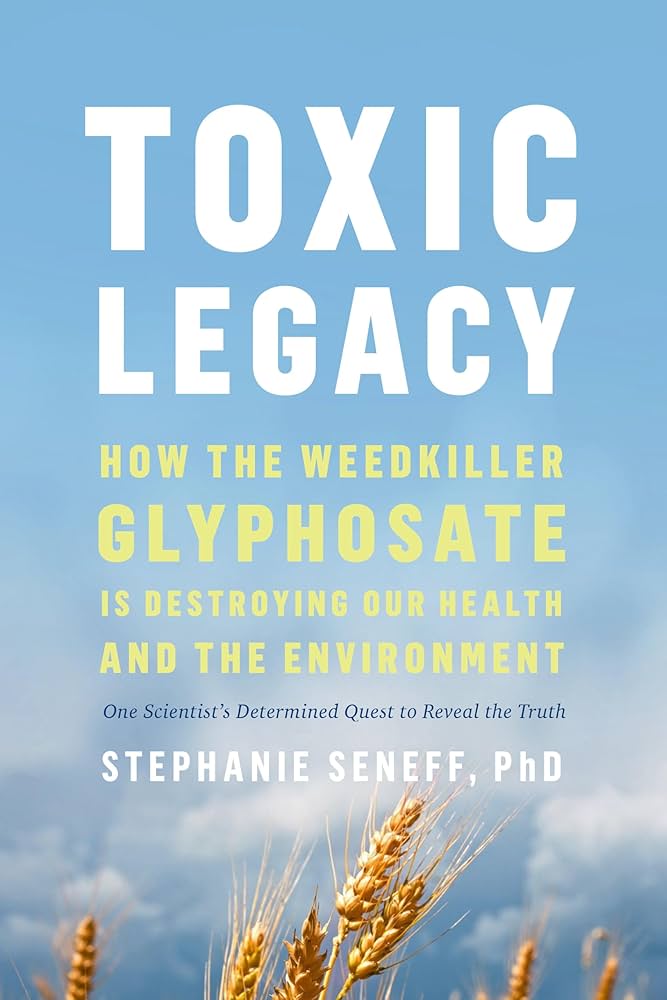
Book Review: Toxic Legacy by Stephanie Seneff, PhD
Last updated: June 2026 Reading time: 16 minutes
Glyphosate is the most widely used herbicide in human history. Since Monsanto introduced Roundup in 1974 and later engineered crops to tolerate it, the chemical has moved from specialty use to ubiquity. It is sprayed on corn, soy, wheat, oats, and dozens of other crops. It is detected in rain, in groundwater, in drinking water, in breast milk, and in human urine across multiple countries. You are almost certainly carrying a measurable residue right now.
That much is not controversial. The regulatory agencies that approved glyphosate knew it would be used at scale. What they did not fully anticipate was how thoroughly it would saturate food systems, water supplies, and human bodies.
Stephanie Seneff's "Toxic Legacy" takes that contamination reality as its launch point and then builds a far larger argument: that glyphosate is not merely a background pollutant but a root driver of the rise in autism, Alzheimer's, cancer, autoimmune disease, digestive disorders, and several other modern epidemics. Her mechanism is specific and novel. She proposes that glyphosate mimics the amino acid glycine and gets incorporated into proteins where glycine should be, corrupting the function of enzymes throughout the body.
This is an important book to read carefully, because it contains two distinct things that require different treatment. The exposure case, the documentation that glyphosate has saturated the food chain and the human body at levels regulators did not foresee, is well-supported and sobering. The disease-causation theory, the glycine-mimic hypothesis and its extension into a unified explanation for modern chronic illness, is a serious proposal from a serious researcher that the current evidence has not confirmed.
Reading it as one homogeneous argument, either swallowing it whole or dismissing it entirely, misses the genuine value and the genuine limits.
Who Is Stephanie Seneff?
Credentials matter in this conversation because Seneff's background is unusual and her critics cite it often.
Seneff is a Senior Research Scientist at MIT's Computer Science and Artificial Intelligence Laboratory. She has a bachelor's degree in biology from MIT and a PhD in electrical engineering and computer science from the same institution. She is not a toxicologist, not a physician, not a biochemist by formal training. She is a computer scientist and data analyst who spent the first decades of her career working on speech processing and natural language systems before pivoting to biology and health research.
That pivot, and what she found when she brought data-pattern analysis to biological datasets, is the origin story of this book. Seneff noticed that the rise in glyphosate use tracked statistically with the rise in autism rates, celiac disease, and several other conditions. She then went looking for a mechanistic explanation that might account for those correlations, and she found the glycine-mimic hypothesis.
Her critics point out that statistical correlation is not causation, that many things tracked with autism rates over the same period (organic food sales, smartphone adoption, Netflix subscriptions), and that a computer scientist making specific biochemical predictions about enzyme function is operating outside her core expertise.
Her defenders point out that interdisciplinary researchers often see patterns domain specialists miss, that her papers have been published in peer-reviewed journals, and that her argument is more than a correlation, it is a proposed biochemical mechanism.
Both of these framings are doing real work, and you need to hold them simultaneously to read the book honestly.
What Toxic Legacy Actually Argues
The book's central argument is not simply that glyphosate is bad for you. It is that glyphosate disrupts biology in a specific and underappreciated way.
The glycine-mimic hypothesis. Glyphosate's molecular structure is similar to glycine, the simplest of the twenty amino acids. Seneff proposes that when the body encounters excess glyphosate, it can mistakenly incorporate glyphosate into proteins in the positions where glycine should be. Glycine holds a crucial role in many enzymes and structural proteins because it is the only amino acid small enough to fit into tight structural spaces, so a glycine substitution with a larger molecule would corrupt the protein's three-dimensional shape and function.
If this mechanism operates as Seneff describes, the implications are substantial. Collagen, which is heavily glycine-dependent, would be structurally compromised. Glyphosate would disrupt the cytochrome P450 enzyme system, which is central to liver detoxification. It would interfere with bile acid synthesis, gut microbiome function, and several other systems. The toxicity would be chronic, cumulative, and difficult to detect because glyphosate passes standard acute-toxicity tests designed to identify immediate harm rather than long-term structural protein disruption.
The sulfate disruption hypothesis. Seneff also argues that glyphosate disrupts sulfate synthesis and transport, which she connects to autism and neurological development. This is the more speculative of her two major mechanisms.
The microbiome argument. Glyphosate was originally patented as an antibiotic before it became a herbicide. Seneff argues that its antimicrobial activity, which is the basis of the patent, is not limited to plants. Residue levels in food may be sufficient to selectively suppress beneficial gut bacteria while leaving pathogenic species more resilient. This microbiome disruption, she argues, contributes to the intestinal permeability and immune dysregulation that underlies many modern conditions.
The unified theory. These mechanisms combine, in her framework, into a single explanation for the correlation between rising glyphosate use and rising rates of several diseases that began trending upward in the late 1990s and early 2000s, roughly matching the timeline of Roundup Ready crop adoption.
The Case That Holds: Glyphosate Is Everywhere
The strongest and most important section of "Toxic Legacy" is the contamination documentation, and on this part of the argument the evidence is solid.
Crop saturation. Glyphosate is now applied to more than 90% of US soybeans, corn, and cotton during growing seasons. It is also used as a desiccant, sprayed on wheat, oats, and other non-GMO crops just before harvest to dry them and simplify harvesting. This pre-harvest application means even non-GMO grain products carry residues. Testing conducted by environmental labs and independent researchers has found glyphosate in oat-based foods at levels that raised concern even among some regulators.
Water and soil. The USGS has detected glyphosate and its breakdown product AMPA in a significant percentage of tested surface water, groundwater, and soil samples in agricultural regions. Glyphosate was assumed to bind tightly to soil and degrade rapidly, but evidence accumulated over decades shows this is context-dependent. In some soils, particularly those low in microorganisms due to prior herbicide use, degradation is slow.
Human biomonitoring. Research published in peer-reviewed journals found measurable glyphosate levels in the urine of people with no direct agricultural exposure. Studies comparing urine samples collected before the broad adoption of Roundup Ready crops with samples collected after found substantial increases in glyphosate burden over time. Breast milk samples have tested positive for glyphosate residues in some studies, a finding with implications for infant exposure during a critical developmental window.
Regulatory miscalculation. The EPA's original acceptable daily intake for glyphosate was set based on studies of direct toxicity at relatively high doses. The broader question of chronic low-dose accumulation in a population consuming trace residues across a wide range of foods simultaneously was not the primary design intent of those studies. Seneff's documentation that the regulatory framework was not designed to answer that specific question is a legitimate criticism, not a fringe claim.
For a detox reader, this contamination case has direct practical relevance. Our glyphosate detox protocol covers what the exposure landscape looks like and what interventions have been studied. Pairing that protocol with the broader considerations in our best water filter for detox guide matters because water is a meaningful glyphosate pathway.
The Glycine-Mimic Hypothesis: Where the Theory Runs Ahead
This is where honest reading requires more care.
The glycine-mimic mechanism is biochemically plausible in concept. Glycine does occupy structurally critical positions in proteins. Glyphosate does structurally resemble glycine. The premise that mistaken incorporation could cause downstream dysfunction is a coherent hypothesis.
The problem is that being coherent and being confirmed are not the same thing.
Demonstrating that glyphosate actually substitutes for glycine in proteins in living organisms at the exposure levels humans experience is a different and more demanding task. It requires controlled experiments showing substitution occurs, that the substitution corrupts protein function in the specific ways predicted, and that this effect operates at the doses present in human tissue from dietary exposure, not only at high experimental doses. That body of confirmatory experimental evidence is not yet assembled.
The cytochrome P450 inhibition argument is better grounded. Research has shown that glyphosate can inhibit CYP enzyme activity, and the CYP system is central to how the liver processes drugs, hormones, and environmental chemicals. Impaired CYP function could amplify the toxic effects of other substances present in the body simultaneously. This mechanism is plausible and has some experimental backing, though the relevant doses and real-world significance remain debated.
The microbiome antibacterial argument also has some supporting evidence. Studies have shown differential sensitivity among gut bacteria species to glyphosate, with some beneficial species more susceptible than certain pathogenic ones. Whether dietary residue levels are sufficient to produce clinically meaningful shifts in human gut microbiome composition is a contested question, with some studies suggesting effects and others finding none at typical exposure levels.
What Seneff does throughout the book is treat these mechanisms as established when they are at different stages of confirmation. The contamination story is established. The mechanistic proposals are at varying degrees of scientific development, from plausible and partly supported to speculative and unconfirmed.
The Correlations That Drive the Book
A significant portion of "Toxic Legacy" rests on statistical correlations Seneff generated or cites between glyphosate use trends and disease incidence trends.
These correlations are striking in their appearance. Lines tracking glyphosate application and autism diagnoses, for instance, trace nearly identical curves across the relevant decades.
The core problem with correlation analysis of this type is a fundamental feature of how diseases, exposures, and time interact. When both a chemical exposure and a disease diagnosis rise simultaneously over the same decades, it can mean the chemical causes the disease. It can also mean both are driven by a third variable. It can mean the disease is being diagnosed more frequently due to changing diagnostic criteria and improved detection, while the exposure is rising independently. It can mean researchers looking for any correlating variable will find one among hundreds of possible candidates.
Autism is the clearest example of the correlation problem. Autism diagnosis rates rose sharply in the 1990s and 2000s, during the same period that glyphosate use was rising. But autism diagnosis rates also rose during that period in countries with dramatically lower glyphosate exposure. The change in DSM diagnostic criteria in 1994, the expansion of early identification programs, and increased awareness among parents and clinicians all contributed to diagnosis rates climbing without necessarily representing a proportional rise in underlying prevalence.
Seneff is aware of these criticisms. She does not ignore them. But her response, pointing to the mechanistic case as evidence that the correlation is not coincidental, circles back to the mechanistic case being the part that still needs stronger experimental confirmation.
This is the central tension in the book: the author is using correlations to motivate the mechanism and the mechanism to justify the correlations, without fully independent confirmation of either at disease-relevant doses in humans.
What a Detox Reader Should Take From This Book
Strip the book to what's actionable for someone actually working on toxic load, and a clear shortlist remains.
Reduce dietary glyphosate exposure. This is supported regardless of where you land on the disease-causation debate. Organic certification prohibits synthetic herbicide use, so organic food carries consistently lower glyphosate burden. For high-exposure foods, particularly oats, wheat, corn, and soy, the shift to organic is the highest-leverage dietary change. Our seed oils guide covers the related class of inputs that often travel alongside industrial grain and soy supply chains.
Filter your water. Reverse osmosis filtration removes glyphosate effectively. Standard carbon filters have more variable performance on herbicides. The best water filter for detox guide covers what the evidence shows about filtration and glyphosate specifically.
Support the CYP pathway. Whether or not glyphosate's mechanism is exactly as Seneff describes, supporting liver detoxification capacity through adequate sulfur amino acids, cruciferous vegetables, and brassica compounds is sound practice with an independent evidence base.
Take the microbiome angle seriously. The question of whether dietary glyphosate residues alter gut microbiome composition in humans is not settled, but the microbiome is sensitive enough that the precaution is reasonable. A diverse, fiber-rich diet supports microbial resilience. The considerations here connect to the magnesium-glycinate discussion in our magnesium glycinate and glyphosate guide, which addresses one of the more specific supplement implications some researchers have proposed.
Contextualize total toxic burden. Glyphosate is one input in a larger picture. No single exposure explains the full modern disease burden. Our glyphosate detox protocol situates it within that broader toxic landscape.
Who Should Read It
Read it if:
- You want the strongest possible case for glyphosate as a meaningful health threat, argued in detail by a researcher who has spent years assembling the evidence
- You are already reducing glyphosate exposure and want the background reasoning
- You can hold a distinction between "this contamination is real and worth addressing" and "this mechanism is confirmed as a disease driver"
- You want to understand how a novel hypothesis gets built, including both its strengths and its current evidential gaps
Read it carefully if:
- You are prone to treating a serious hypothesis as a proven mechanism once you have encountered a compelling argument for it
- You want to understand glyphosate toxicity as part of a total toxic load picture, rather than as the singular explanation for modern illness
Approach with more caution if:
- You are drawn to unified disease theories and want this one to be the final answer. Chronic disease is multifactorial, and no single compound accounts for the full picture even if glyphosate is doing real harm
- You are making medical decisions based on Seneff's specific disease-causation claims rather than the contamination and exposure data
The Bottom Line
Stephanie Seneff has written a book that performs two functions at different levels of evidentiary support, and the reader's job is to keep them separate.
The documentation that glyphosate has saturated the food system, water supply, and human body at levels beyond what the regulatory framework was designed to assess is thorough, grounded, and important. Anyone who reads this section carefully and then continues eating conventional oats and drinking unfiltered tap water without at least considering the question has missed something real.
The glycine-mimic hypothesis, as a unified explanation for rising rates of autism, Alzheimer's, cancer, and autoimmune disease, is a serious proposal from a non-specialist researcher who spotted patterns that specialists may have missed, and who constructed a coherent mechanistic story to explain them. It has not yet been confirmed at the level of detail and rigor the claims require. Biochemical plausibility is a starting point for scientific investigation, not the endpoint.
Read the contamination case as fact. Read the mechanistic theory as a serious hypothesis worth following as the research develops. Act on the exposure reduction regardless, because reducing glyphosate burden is sound practice on the evidence that already exists.
The frustrating reality about glyphosate is that the question of its long-term health effects at chronic low doses may not be fully resolved for another decade. In the meantime, the contamination is present and measurable, and reducing your exposure costs nothing except the premium on organic food and a water filter.
That is the practical takeaway from this book. The larger theoretical structure is worth understanding, and worth watching, but not yet worth treating as settled science.
Related MadWorldDetox Guides
- Glyphosate Detox Protocol - What the exposure landscape looks like and what interventions have been studied
- Seed Oils: Why Avoid Them - The related class of industrial inputs that travels alongside the same supply chains
- Magnesium Glycinate and the Glyphosate Connection - Specific supplement implications some researchers have proposed
- Best Water Filter for Detox - Filtration options and their effectiveness against herbicide residues
Products Mentioned
The Book:
Toxic Legacy: How the Weedkiller Glyphosate Is Destroying Our Health and the Environment, Stephanie Seneff, PhD. The detailed case for glyphosate as a pervasive biological disruptor, from contamination documentation to mechanistic hypothesis.
Affiliate Disclosure: This review contains affiliate links. We may earn a small commission on purchases made through these links at no additional cost to you. We only recommend books and products we've researched and believe provide value. Our assessment of the book itself is independent of any affiliate relationship.
Last updated: June 2026