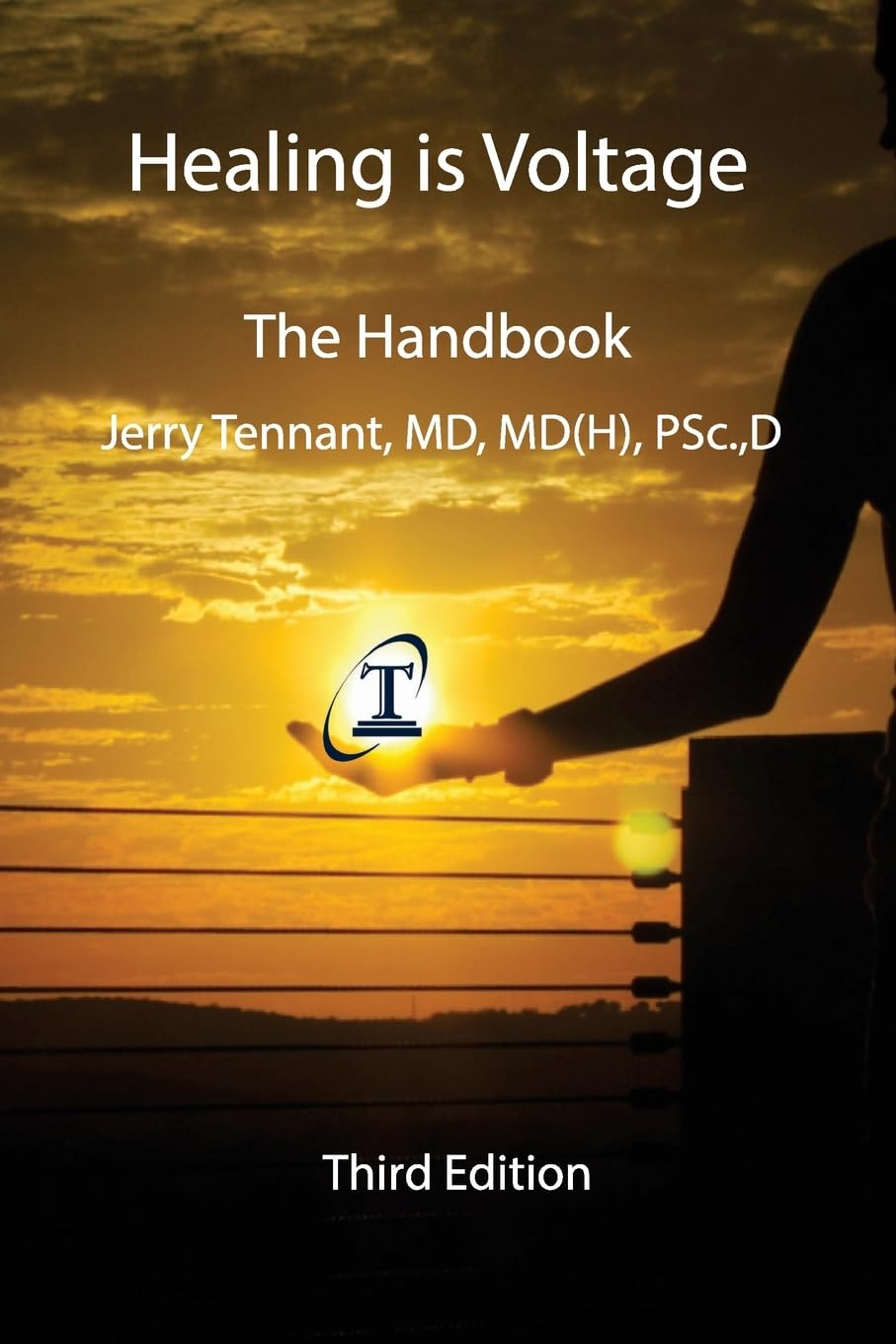
Book Review: Healing is Voltage: The Handbook by Jerry Tennant, MD
Last updated: June 2026 Reading time: 15 minutes
In 1995, Jerry Tennant was one of the best eye surgeons in the United States, one of the first Americans trained to perform LASIK, working under the doctor who invented the procedure. Then he contracted three viruses simultaneously while operating on a patient with undiagnosed herpes encephalitis. The viruses attacked his brain. Over the following years he lost the ability to think clearly, to drive, to work. He slept up to eighteen hours a day. Mainstream medicine told him his case was untreatable.
He spent seven years in that condition before he began recovering, not through conventional medicine, but by reverse-engineering his own physiology. He started studying why cells heal, what they require to do it, and what blocks them. The model he arrived at, which became Healing is Voltage: The Handbook, is the subject of this review.
Tennant's core argument: the body is fundamentally an electrical system. Cells run on voltage. When voltage drops below what they need to function, you get chronic disease. When you restore adequate voltage, healing becomes possible again. Every protocol in the book follows from that premise.
The idea sounds simple, almost reductive. It's also considerably more grounded in real biology than it might first appear, and considerably more speculative in some other directions. This review will walk through what Tennant actually argues, where the model maps to established physiology, where it reaches beyond the evidence, and who this book is genuinely for.
Who Jerry Tennant Is
Board-certified in ophthalmology and ophthalmic plastic surgery (residencies at Harvard Medical School and Southwestern Medical School), Tennant was a credentialed, conventional physician before his illness. He founded the Tennant Institute for Integrative Medicine in Irving, Texas, where he later treated patients using the bioenergetic framework developed in the book.
His background matters because it shapes how he writes. This is someone trained in surgery and physiology who also spent years studying acupuncture, traditional Chinese medicine, and bioelectric medicine. The result is a book that moves fluidly between cellular biology and energetic medicine, which is both its strength and its weakness depending on where you are on that continuum.
Tennant's personal illness is not incidental backstory. It's load-bearing: the entire model was constructed to explain his own recovery and to systematize what he found. That gives the book the texture of a clinician's working notebook more than a polished popular-science text.
The Core Thesis: Cells Need Voltage to Heal
Tennant's central claim is specific and falsifiable in its basic form: healthy cells run at around -25 millivolts (mV). To heal, to make new cells, they need -50 mV. Chronic disease, in his framework, occurs when the body cannot generate or sustain -50 mV in the affected tissue.
This is not a metaphor. Cell membrane potential is a real, measurable quantity. Every cell in the body maintains an electrochemical gradient across its membrane, generated by ion pumps (primarily sodium-potassium ATPase). Standard figures in physiology textbooks put resting membrane potential in most cells between -40 and -90 mV, with the exact value varying by cell type. Tennant's numbers fall within the range of the relevant literature. The idea that adequate membrane potential is necessary for normal cell function is textbook physiology.
The extension he makes from this foundation is where his model becomes its own thing: he identifies body pH as a direct expression of voltage in fluids. Because the human body is mostly water, and because ions in solution carry charge, alkaline conditions (more electron donors, more negatively charged) correspond to higher voltage. Acidic conditions correspond to lower voltage. A tissue that tests acidic is, in Tennant's reading, a tissue running short of electrons.
This pH-voltage equivalence is his organizing diagnostic. An organ that reads too acid on testing has low voltage. Low voltage means it cannot make new cells at the rate needed to replace dying ones. An organ that cannot replace its cells breaks down. That, for Tennant, is the definition of chronic disease.
The Battery Systems: Where Voltage Comes From
Tennant argues the body has several systems that generate and store voltage. Understanding what they are and how they can be depleted is the practical center of the book.
Mitochondria. The classical cellular powerhouses. They produce ATP, the currency of cellular energy. Tennant's model treats mitochondrial health as foundational to voltage production.
Cell membranes as capacitors. Membranes store charge. Damage to them, from toxins, oxidative stress, nutrient deficiency, reduces the body's ability to hold the voltage it generates.
Muscle movement and piezoelectricity. When compressed, certain biological materials generate an electrical charge. Tennant draws on piezoelectricity (the charge produced by mechanical stress in crystalline structures) to argue that movement itself charges the body. Connective tissue, bone, and muscle all exhibit piezoelectric properties, this is real, documented physics applied to biology.
Acupuncture meridians. Here the model shifts. Tennant argues that meridians are real physical structures, channels that conduct voltage to specific organs. He maps them to the body's fascial and muscle layers and argues that organ-level voltage can be supported or disrupted through the meridian network. This is where the reader has to decide how far to follow.
The meridian-as-circuit model is plausible as a conceptual framework; some researchers have found that acupuncture points have measurably different electrical conductance than surrounding tissue. But "measurably different" is a long way from a validated network of organ-charging circuitry. Tennant presents it as established anatomy.
What Drains the Battery
The diagnostic and clinical section of the book is organized around what depletes voltage. Several of these are uncontroversially real.
Thyroid dysfunction. Tennant argues that thyroid hormones directly regulate cell membrane voltage, T3 affects membrane potential, T2 supports mitochondrial energy production. Hypothyroidism, therefore, is a primary cause of low cellular voltage. This maps to well-established physiology: thyroid hormones genuinely regulate oxidative phosphorylation and cellular metabolism, and low thyroid function is associated with widespread systemic symptoms. His framing as "voltage" is a reframe, but the underlying biology is solid.
Scars. Scar tissue, Tennant argues, can act as an electrical short circuit, disrupting the voltage flowing through the meridian to the organ on that circuit. He describes treating chronic conditions by identifying and treating scars with microcurrent. The idea that scars disrupt energy flow is found in osteopathy, acupuncture, and neural therapy traditions. Whether it works the way Tennant describes is a different question from whether the observation that scars matter for systemic function is real, there's reasonable clinical evidence for the latter.
Dental infections and root canals. Each tooth, in Tennant's model, sits on a meridian and therefore connects to an organ circuit. An infected tooth, a root canal, or a cavitation (unresolved bone infection in the jaw) can shut down the circuit for the organ it serves. He presents figures about the prevalence of jawbone and root canal involvement in cancer patients at his clinic. These are observational clinical observations, not controlled evidence, but the biological plausibility of oral infections having systemic effects is not fringe, chronic dental infections are increasingly recognized as cardiovascular and systemic disease risk factors in mainstream medicine.
Toxins. Heavy metals, pesticides, glyphosate, mold biotoxins, Tennant identifies these as electron stealers that drain voltage at the cellular level. The mechanism fits within his framework and the broad category (environmental toxins disrupt cellular function) is well established. The specific mechanism (they reduce membrane potential) is a plausible pathway that hasn't been comprehensively validated at the voltage level.
Emotional stress. Tennant argues that unresolved emotional trauma stores as a magnetic field in tissues and teeth, disrupting voltage. This is the point in the model where most conventional clinicians will stop. The claim extends well beyond what the evidence can support, and the book presents it as established fact rather than hypothesis.
Nutrient deficiencies. Raw materials for new cells. If you lack the ions, minerals, and molecules to build cellular hardware, voltage alone cannot produce healing. This is the least controversial element.
Where the Model Maps to Real Physiology
The voltage framework has genuine explanatory power for phenomena that conventional medicine describes in different terms.
Membrane potential is foundational. The cell biology is real. Sodium-potassium ATPase uses cellular energy to pump ions across the membrane, maintaining the voltage gradient that allows cells to receive signals, produce energy, and function. When that system fails, through energy deprivation, toxin exposure, or mitochondrial damage, the cell cannot do its job. Tennant's language is not textbook language, but the phenomenon he's pointing at is real.
pH genuinely matters at the cellular level. Intracellular pH affects enzyme activity, mitochondrial function, and the rate of cellular repair. Acidic environments in tissues are associated with inflammation, impaired healing, and poor oxygen delivery. Tennant's mapping of pH to voltage is a simplification (pH measures hydrogen ion concentration, not directly the electron donor/acceptor balance, though these correlate), but the clinical observation that alkaline tissues function better is not baseless.
Grounding (earthing) and electron donation. One of Tennant's recommendations is direct contact with the ground, which he describes as providing free electrons. The grounding literature, covered in our grounding and earthing detox guide, documents measurable physiological effects (reduced inflammatory markers, normalized cortisol rhythms) in peer-reviewed studies. Tennant's voltage-based explanation for these effects may or may not be the right mechanism, but the effects he's trying to explain are real.
PEMF and bioelectric medicine. Pulsed electromagnetic field therapy, covered in our PEMF therapy guide, works on the same basic premise: external electromagnetic fields can influence cellular function. FDA-cleared PEMF devices exist for bone healing and depression. Tennant is building on a tradition, Robert O. Becker's The Body Electric is the foundational text here, that has produced real clinical results even before its mechanisms are fully characterized.
pH as a practical detox variable. The relationship between pH balance and detoxification pathways is explored in our detox and pH guide. Tennant's model gives one specific mechanistic account of why this connection matters.
Where the Model Reaches Beyond the Evidence
Steelmanning the framework is easier than the book sometimes deserves, because Tennant doesn't always distinguish between the well-grounded and the speculative parts of his own model.
The specific millivolt claims. The -25 mV and -50 mV figures are real enough as general characterizations of membrane potential in certain cell types. But membrane potential varies enormously by cell type (neurons run very differently from epithelial cells from cardiac muscle). Presenting single numbers as universal targets simplifies past what the physiology supports.
Meridians as proven electrical circuits. The book treats meridians as established electrical anatomy. They are a traditional medical framework that has produced clinically useful interventions; whether they are literal voltage conduits to organs is a separate question. Tennant presents the more ambitious claim without sufficient qualification.
Emotional trauma as stored magnetic fields. The claim that unresolved emotional events create measurable magnetic disturbances in tissues, detectable and treatable in the ways Tennant describes, does not have experimental validation. The clinical observation that emotional events precede illness is real and documented. The proposed mechanism is a bridge too far from the evidence.
The tooth-organ circuit maps. The idea that specific teeth are bioenergetically linked to specific organ systems is drawn from acupuncture literature and German neural therapy, and practitioners have used it clinically. Tennant presents it with a confidence the evidence base doesn't fully justify.
The 95% cancer figure. Tennant cites clinical observations from his own practice about the prevalence of dental infections and root canals in cancer patients. These are not controlled studies. Selection bias is significant: people who come to the Tennant Institute already skew toward those who've explored alternatives to conventional care, many of whom have complex, hard-to-treat cases.
None of this means the clinical approaches fail. Many people report meaningful improvement following the protocols. But there's a gap between "this approach helps some patients" and "we understand exactly why it works," and the book collapses that gap more often than it should.
How This Fits a Real Detox Practice
Strip Tennant's model to what's actionable and independently grounded, and a useful core remains.
Support mitochondrial function. If cellular energy production is the foundation of healing, anything that supports mitochondria matters: nutrients (magnesium, B vitamins, CoQ10), sleep, movement, cold and heat exposure, reducing toxic load. Red light therapy in the near-infrared range has documented effects on mitochondrial cytochrome c oxidase; our red light therapy guide covers this.
Reduce the toxin drain. Tennant's identification of heavy metals, mold toxins, pesticides, and dental metals as electron stealers that disrupt cellular voltage aligns with the detox literature generally. The specific voltage mechanism may be one of several ways these compounds disrupt cellular function.
Move more, literally. The piezoelectricity claim, that movement charges the body, is an interesting reframe on exercise that gives it a direct cellular rationale beyond cardiovascular fitness. Walking barefoot on the earth works doubly in this model.
Pay attention to oral health. Whether or not you accept the tooth-organ circuit model, the mounting evidence that oral infections have systemic consequences makes dental health a meaningful detox variable. Conventional medicine has arrived at similar clinical territory through different reasoning.
Use grounding and PEMF as complementary tools. Both have evidence for physiological effects. Tennant's framework gives them a coherent rationale, even if the exact mechanism remains under investigation.
Check thyroid function. Tennant's treatment of thyroid as the master voltage regulator aligns with the functional medicine perspective that subclinical thyroid dysfunction is underdiagnosed and consequential. If chronic disease is the presenting problem and thyroid hasn't been properly evaluated, that's an oversight.
Who This Book Is For
Read it if:
- You're a biohacker or integrative health practitioner who wants a unified electrical model of physiology to think with, understanding that some of it is framework rather than established fact
- You've tried multiple conventional and alternative approaches for chronic illness and want a different explanatory lens
- You're already familiar with bioelectric medicine (Becker, Oschman, Lipton) and want Tennant's clinical application
- You're exploring PEMF, grounding, or microcurrent therapy and want the theoretical backing behind the tools
- You're dealing with chronic disease that conventional medicine has characterized as untreatable and you want to understand Tennant's clinical reasoning
Read it carefully, or skip it, if:
- You want peer-reviewed evidence for every claim. Tennant's framework extends significantly beyond the controlled trial literature
- You take clinical case observations as equivalent to randomized controlled evidence
- You're looking for a step-by-step protocol. The book is conceptual more than procedural; extracting clear implementation guidance requires effort
- The speculative sections (emotional trauma as magnetic fields, specific tooth-organ circuits presented as fact) will derail your engagement with the parts of the model that are better supported
The Bottom Line
"Healing is Voltage" is the work of a credentialed physician who got sick, couldn't be helped, and reverse-engineered a framework to explain his own recovery. Some of that framework maps closely to real cell biology, membrane potential, mitochondrial function, pH as a tissue health proxy, piezoelectricity, the documented effects of grounding and PEMF. Some of it imports from traditional systems (meridians, tooth-organ relationships) with more confidence than the evidence justifies. Some of it ventures into territory, emotional trauma as stored magnetic fields, specific millivolt targets as universal medicine, that requires the reader to extend significant interpretive charity.
Tennant is not making things up. He's building a unified model to explain clinical observations from his own practice. The frustration is that the book presents the whole model at roughly the same level of confidence, making it difficult for a careful reader to know where solid ground ends and where the speculative begins.
The concept that cells need adequate voltage to heal is sound enough to organize a detox practice around. The question is whether you need the full Tennant framework, or just the actionable core: support mitochondria, reduce toxic load, support the thyroid, move regularly, consider grounding and bioelectric tools, take oral health seriously. Those recommendations land whether or not you accept every element of the bioenergetic model behind them.
For a certain reader, one who finds the electrical body model compelling, who already operates at the intersection of conventional physiology and energetic medicine, who is comfortable holding a framework provisionally, this book is a genuinely useful read. For a reader who needs the evidence to be airtight before anything lands, it will frustrate before it helps.
Related MadWorldDetox Guides
- Does Detox Depend on pH? - How tissue acidity connects to detoxification capacity
- PEMF Therapy Guide - Pulsed electromagnetic field therapy and what the evidence actually shows
- Grounding and Earthing Detox Guide - The peer-reviewed case for direct earth contact as a health intervention
- Red Light Therapy Guide - Near-infrared light and its documented effects on mitochondrial function
Products Mentioned
The Book:
Healing is Voltage: The Handbook - Jerry Tennant, MD. A bioenergetic model of chronic disease organized around cellular voltage and pH, drawing on Tennant's own recovery from viral encephalitis and subsequent clinical practice.
Affiliate Disclosure: This review contains affiliate links. We may earn a small commission on purchases made through these links at no additional cost to you. We only recommend books and products we've researched and believe provide value. Our assessment of the book itself is independent of any affiliate relationship.
Last updated: June 2026