Book Review: The 3-Season Diet by John Douillard
Last updated: June 2026 Reading time: 13 minutes
Almost every detox book in existence operates on the same assumption: the body has accumulated a problem that requires a concentrated intervention to fix. A weekend fast. A 21-day cleanse. A protocol. Something intense, something bracketed, something you do and then stop.
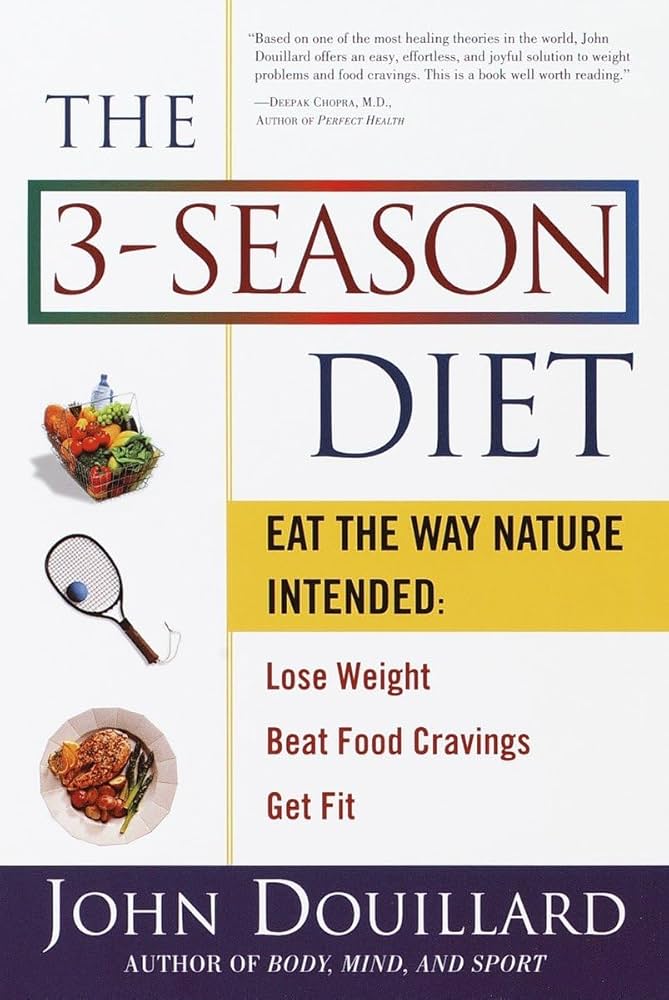
John Douillard's argument in "The 3-Season Diet" is that this framing is wrong from the start. The body was never meant to detox in episodes. It was designed, according to both evolutionary biology and Ayurvedic medicine, to cleanse continuously, and the mechanism for that continuous cleansing is seasonal eating. When you stop eating with the seasons, the mechanism breaks. The "detox" you feel you need is the price of that break.
This is an old argument made newly interesting by how much of it turns out to have a biological basis. Douillard is a chiropractor, Ayurvedic practitioner, and former professional triathlete who has spent decades applying classical Indian medicine to Western patients. He is not writing as a theorist. He is writing as someone who watched seasonally aligned eating resolve complaints that years of conventional advice had not.
"The 3-Season Diet" is not a cleanse manual. It is a framework for understanding why you feel worse than you should despite trying hard, and a practical system for eating in a way that supports digestion, weight regulation, and continuous detoxification as a default state rather than an emergency measure.
Who Douillard Is and Why He Wrote This
John Douillard's background is unusual in the Ayurvedic space. He trained as a chiropractor, competed as a professional triathlete, and then spent years studying under Maharishi Mahesh Yogi and Deepak Chopra before establishing his own practice, LifeSpa, in Boulder, Colorado. He has written several books applying Ayurvedic principles to modern health problems.
His particular edge in "The 3-Season Diet" is that he bridges classical Ayurvedic theory with what he calls the evolutionary logic underneath it. He argues that the same seasonal patterns Ayurveda describes were the conditions under which human digestion evolved. This is not woo dressed up as science, though it is not published science either. It is a coherent interpretive framework, and worth engaging with on those terms.
The book emerged from his clinical observation that patients who ate according to season consistently showed improvement in weight, energy, digestion, and what he describes as their overall "constitutional strength." He wanted to explain why, and to give readers a map they could actually follow.
The Central Argument
Douillard's thesis works on two levels simultaneously.
The first level is evolutionary. For most of human history, people had no choice but to eat what was available in each season. Spring brought light greens, bitter shoots, and cleansing foods. Summer brought an abundance of fruit, hydrating foods, high-carbohydrate produce. Autumn brought root vegetables, dense starches, heavier animal proteins, and fats. Winter brought the leanest eating of all. This pattern, repeated year after year, created a metabolic rhythm: a period of weight gain before winter, a period of cleansing in spring, and a period of high physical output and carbohydrate loading in summer to match the long days of activity.
The second level is Ayurvedic. Classical Ayurveda describes the same seasonal cycle in terms of agni, the digestive fire. Agni is the concept that organizes everything else in this book. It refers to the totality of digestive and metabolic function: the capacity to break down food fully, absorb nutrients cleanly, and process waste without accumulation. Strong agni means efficient digestion and continuous self-cleansing. Weakened agni means food is incompletely processed, waste accumulates in the tissues, and chronic low-grade toxicity follows.
Douillard's argument is that these two descriptions, the evolutionary and the Ayurvedic, are pointing at the same underlying biology. The seasonal eating patterns that human digestion evolved for are the same patterns Ayurveda recommends for maintaining strong agni. Eating processed, year-round uniform diets disrupts both.
The Three Seasons Explained
Douillard divides the year into three eating seasons, each with a distinct food profile and a distinct function.
Spring is the cleansing season. The traditional spring diet was naturally low in fat, low in sweet foods, and high in bitter, light, and astringent foods: dandelion greens, leafy vegetables, berries, and light grains. This mirrors how Ayurveda describes the appropriate spring diet for clearing accumulated kapha (the heavy, mucus-like accumulation that builds over winter) and reviving digestive fire after the heavier eating of cold months. The body's lymphatic system, according to Douillard, is particularly active in spring, and the spring diet supports that natural lymphatic movement.
Summer is the high-activity season, and the diet reflects it. Nature provides sweet fruits, cooling vegetables, and high-carbohydrate foods that match the energy demands of long, physically active days. Douillard is specific here: summer is not the season for avoiding carbohydrates. It is the season nature designed for higher carbohydrate intake, stored as fuel for sustained output. The mistake many people make, he argues, is importing year-round carbohydrate restriction into a season that evolutionarily demanded the opposite.
Autumn and winter form the third season in Douillard's framework. The traditional diet of cold months was heavier: root vegetables, fermented foods, animal fats, and denser proteins. These foods support warmth, tissue building, and the kind of deep nourishment that prepares the body for the next year. This is the season for the richest eating, and the season most directly connected to what Douillard calls constitutional restoration, rebuilding the reserves that sustained activity and cleansing depleted.
Agni: The Engine of Continuous Detox
The most practically useful section of the book is Douillard's treatment of digestive strength. He argues that the root cause of most chronic complaints, weight resistance, fatigue, brain fog, skin issues, and food sensitivities, is weakened agni. And the cause of weakened agni, in his framework, is not a single insult but the cumulative effect of eating against the body's natural rhythms.
His diagnostics for agni are readable and specific. He describes what strong digestion feels like: complete hunger before meals, no bloating or heaviness after eating, regular elimination, steady energy without crashes, and no undigested food visible in the stool. By those standards, a significant number of people in modern environments have weakened agni, eating processed food year-round with no seasonal variation, snacking constantly (which he argues interrupts the digestive cycle), and consuming foods that have traveled thousands of miles out of season.
The interventions he recommends for rebuilding agni are practical rather than exotic. Eating the largest meal at midday, when digestive fire peaks. Avoiding ice-cold drinks, which he says dampen digestive fire. Allowing genuine hunger to develop before eating rather than eating on a schedule. Using spices that stimulate digestion, particularly ginger, cumin, and coriander. Tongue scraping in the morning to clear the accumulated coating that indicates digestive residue (the same practice described in our tongue scraping guide). These recommendations are recognizable from both Ayurvedic tradition and, more recently, from functional medicine practitioners who have arrived at similar conclusions via different routes.
What the Science Says and Where It Goes Quiet
The honest assessment of this book requires distinguishing between what it explains and what it proves.
Where Douillard is on solid ground: the chronobiology of digestion is real and increasingly documented. Digestive enzyme activity, gastric acid production, and gut motility all follow circadian and seasonal rhythms. The gut microbiome shifts in composition across seasons in populations that still eat traditionally, with measurable changes in diversity and function. Bitter foods and fiber-rich spring vegetables genuinely stimulate bile flow and support liver function. Fasting windows, which Douillard recommends implicitly through his midday-main-meal approach, have a growing body of support for metabolic and digestive benefits. His recommendation aligns with what intermittent fasting research has since confirmed (see our intermittent fasting and detox guide).
Where the science goes quiet: agni as a measurable physiological entity does not exist in conventional medicine. The specific claims about seasonal eating correcting accumulated toxicity in the tissues are not verifiable by standard methods. The evolutionary argument that human digestion "expects" a specific seasonal pattern is plausible but not falsifiable in the way a clinical trial would be. Douillard draws on Ayurvedic tradition and his own clinical observation, both of which carry weight, but neither constitutes proof by the standards that would satisfy a skeptic.
The deeper question worth sitting with is whether the absence of randomized controlled trials disqualifies a framework that has produced consistent results across thousands of years of practice. Douillard would say no. A rigorous evidence-based reader might say the clinical evidence is needed before making strong claims. Both positions are defensible. What real detox requires, at minimum, is that the interventions make biological sense and do no harm, and by those criteria the seasonal eating framework passes (see our what real detox requires guide for the full framework).
It is also worth noting that Douillard does not overstate his case. He is not promising that seasonal eating will cure disease. He is arguing that it will restore the conditions under which the body manages itself better. That is a more limited and more honest claim than many detox books make.
The Practical Protocol
Translating the three-season framework into daily life looks something like this.
In spring, emphasize leafy greens, bitter vegetables, sprouts, berries, and light grains. Reduce heavy dairy, fried foods, and dense starches. Allow the eating window to be somewhat restricted, in keeping with the lighter natural appetite of the season. This is also the season Douillard recommends for any more intentional cleansing, because the body's natural cleansing mechanisms are most active.
In summer, eat freely from seasonal fruits, cooling vegetables, and higher-carbohydrate whole foods. This is not a license for processed carbohydrates, but it is a reason to stop fighting the body's appetite for sweet, hydrating, high-energy foods during long active days. Support digestion with adequate hydration and spices.
In autumn and winter, shift toward root vegetables, warming soups, cooked whole grains, healthy fats, and if appropriate for your diet, denser animal proteins. The goal is nourishment and warmth. Avoid raw, cold, and light foods that deplete digestive fire during cold months.
Across all seasons, the consistent daily practices Douillard recommends are: eating the largest meal at noon, avoiding snacking between meals, using warming spices, tongue scraping in the morning, and eating primarily cooked rather than raw food during cold months. The six healing sounds practice he does not address directly, but the organ-support logic of his seasonal framework connects naturally with energetic approaches to detoxification (see six healing sounds for organ detox for the Taoist parallel).
Camps Worth Knowing
Douillard occupies a specific position in a broader conversation about seasonal and circadian eating, and it helps to know the terrain.
Functional medicine practitioners who recommend circadian-aligned eating largely agree with his core timing recommendations (large midday meal, fasting window overnight) but approach it through the lens of chronobiology rather than Ayurveda. The biology underlying both frameworks is increasingly consistent.
Critics of Ayurvedic medicine point out that constitutional typing (vata, pitta, kapha) has not been validated by the methods that would satisfy a clinical researcher, and that claims about ama (accumulated undigested matter) as a disease entity remain outside conventional medicine's framework.
The practical-use camp, which includes many integrative and functional practitioners, finds that applying the seasonal framework produces measurable clinical improvements regardless of whether the underlying theory is validated to the satisfaction of a skeptical journal reviewer. That gap between mechanistic proof and clinical utility is real, and Douillard sits in it without apology.
MadWorldDetox's read: the framework is coherent, the daily practices are low-risk and plausibly useful, and the seasonal structure provides a simpler organizing principle for long-term food choices than most dietary systems. The Ayurvedic framing should be taken as a map, not a mechanism.
Who Benefits, Who Should Be Cautious
Read it if:
- You are interested in Ayurvedic medicine and want a practically applicable entry point that bridges classical theory with accessible recommendations
- You have been through repeated targeted cleanses without lasting results and want a different frame for thinking about the same goal
- You find food timing and digestive rhythm more interesting than macronutrient ratios, and you want a book that treats digestion as the primary variable
- You are interested in how the seasonal eating patterns of traditional cultures might apply to a modern life
Read it carefully if:
- You are managing a specific diagnosed condition and are looking for evidence-based dietary protocols. Douillard's framework may be useful as a complement, but it is not a clinical protocol and should not replace one
- You are entirely new to Ayurvedic concepts. The framework takes some acclimation, and a reader who needs every claim sourced to a peer-reviewed study will find this book frustrating
- You are in a health situation where consistent structured eating is medically important. The season-based flexibility can be genuinely freeing for most people, but it assumes a baseline of dietary stability
The Bottom Line
"The 3-Season Diet" makes an argument that the detox conversation rarely makes: that the body's capacity for self-cleansing is not broken, it is merely unsupported. Supporting it does not require a protocol or a week of suffering. It requires eating with the season, protecting digestive strength, and trusting the slow accumulation of right conditions over time.
That argument is traditional, partially supported by modern biology, and not fully proven by controlled evidence. Readers who need the latter will leave unsatisfied. Readers who find the synthesis of evolutionary logic and Ayurvedic tradition persuasive, and who are looking for a sustainable dietary framework rather than a quick intervention, will find this one of the more coherent books in the genre.
Douillard earns his recommendation by being honest about what the framework is: a system built from thousands of years of clinical observation, now increasingly intersecting with modern chronobiology, but not a treatment and not a cure. Seasonal eating, strong agni, consistent daily practices. The body does the rest.
Related MadWorldDetox Guides
- What Real Detox Requires - The foundational criteria any approach has to meet before it earns the name
- Intermittent Fasting and Detox - The modern chronobiological case for time-restricted eating, which intersects with Douillard's midday-meal principle
- Six Healing Sounds for Organ Detox - The Taoist parallel to seasonal organ support, working with similar organ-function logic from a different tradition
- Tongue Scraping Guide - The morning practice Douillard recommends as a daily indicator of digestive residue and a front-line clearing tool
Products Mentioned
The Book:
The 3-Season Diet - John Douillard, DC, PhD. Ayurvedic seasonal eating framework for continuous digestive health and natural detoxification.
Affiliate Disclosure: This review contains affiliate links. We may earn a small commission on purchases made through these links at no additional cost to you. We only recommend books and products we've researched and believe provide value. Our assessment of the book itself is independent of any affiliate relationship.
Last updated: June 2026