Book Review: Iodine: Why You Need It, Why You Can't Live Without It by David Brownstein, MD
Last updated: June 2026 Reading time: 15 minutes
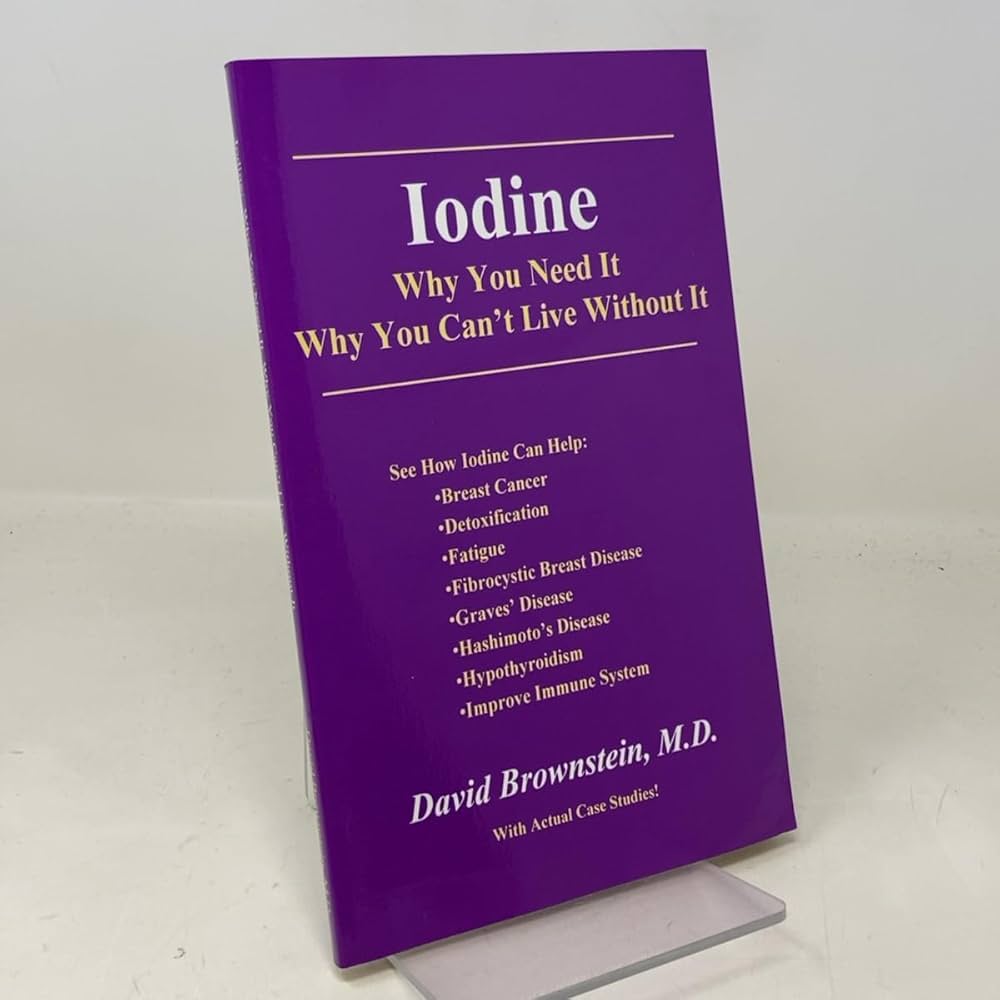
Iodine is one of the few minerals that got its own mass public-health campaign. In the early twentieth century, goiter, the swelling of a starved thyroid, was endemic across the American Midwest. The solution was a stroke of industrial simplicity: add iodine to table salt. Goiter rates collapsed. The problem, medicine concluded, was solved.
David Brownstein, MD, disagrees with that conclusion. In "Iodine: Why You Need It, Why You Can't Live Without It," he argues that the iodized-salt strategy was too small a fix for a much larger and still-active problem. The iodine that goes into most table salt is a fraction of what the body actually needs, delivered in a form the body doesn't absorb well, and it gets into the diet less reliably than it once did as people moved away from processed salt. Meanwhile, a separate set of problems has been building in the background: the widespread presence of bromine and fluoride in the modern environment, both of which, Brownstein argues, compete directly with iodine for the same receptor sites in the body. Add it up, and the picture he draws is one of a population that believes a mineral deficiency was solved seventy years ago while quietly accumulating that deficiency every day.
This is not a fringe premise. Iodine deficiency remains the leading preventable cause of intellectual disability worldwide. The question Brownstein raises is harder than the fringe label usually allows: how far has modern exposure to halide competitors pushed that deficiency in populations that consider themselves well-nourished? That question is real, the book's answer is specific and aggressive, and the honest read of it requires holding both things at once.
Who David Brownstein Is
David Brownstein is a board-certified family physician in private practice in Michigan who has written several books on what he describes as "holistic medicine." He holds an MD from the University of Michigan and completed residency in family medicine. He is not a biochemist or endocrinologist, and his approach to nutrient dosing places him well outside mainstream medical consensus. He has a clinic, a radio program, and a large following in the functional medicine and nutritional therapy communities.
Brownstein's books are positioned within the holistic-medicine tradition, and his claims often exceed what the clinical trial literature currently supports. That does not make the underlying mechanisms he describes wrong. It means they should be read as a clinician's synthesis of case experience, mechanistic biochemistry, and historical precedent, not as the output of controlled research.
The Central Thesis: A Deficiency That Was Never Actually Fixed
Brownstein builds his case on several interlocking arguments.
Iodine is not only a thyroid mineral. This is his first and most important reframe. Standard medical education teaches iodine as a single-purpose nutrient: the thyroid needs it to make T3 and T4. Brownstein draws on historical and biochemical work to argue that the thyroid is only one consumer in a widespread bodily need. Breast tissue concentrates iodine. So do the ovaries, the prostate, the skin, and the salivary glands. His argument is that the RDA was set for thyroid function specifically, not for whole-body sufficiency, and that the gap between "enough iodine for your thyroid" and "enough iodine for your whole body" is significant.
The Japanese comparison. Brownstein returns repeatedly to dietary iodine intake estimates from Japan, where seaweed consumption pushes average intake far above Western levels, and where rates of certain diseases including fibrocystic breast disease have historically been lower. He points to researchers who estimated traditional Japanese intake in the milligrams-per-day range. This comparison is genuinely striking, and it forms the foundation of his argument for higher-dose supplementation.
The halide displacement thesis. This is the book's most distinctive and controversial idea. Iodine belongs to the halide family of elements, alongside bromine, fluorine, and chlorine. Brownstein argues that these other halides compete with iodine for the same receptors in the body, that they have flooded the modern environment through specific pathways: bromine in commercial bread (where it replaced iodine as a dough conditioner starting in the 1970s and 1980s), brominated vegetable oil in soft drinks, and bromine-containing pesticides in food; fluoride in municipal water supplies, toothpastes, and processed foods; chlorine in water. When the body is chronically short on iodine and chronically flooded with competing halides, the receptors that should be occupied by iodine fill with these substitutes instead. Displacement, in his framework, is both a cause of deficiency and a source of the symptoms people experience when they begin supplementing.
The "bromide detox" effect. Brownstein describes a phenomenon that many of his patients apparently experienced when beginning iodine supplementation: acne, fatigue, brain fog, and a range of other symptoms that he interprets as the body excreting displaced bromide from tissues. He treats these as a sign that the supplementation is working, not a sign that something is wrong. This interpretation is central to the book and also among its most contested claims.
What the Steelman Looks Like
Take the strongest version of Brownstein's thesis seriously, because there are real mechanisms underneath it.
The competition between iodine and other halides for receptor sites is biochemically documented, not invented. Fluoride displacing iodine in thyroid tissue has been observed in animal studies. Bromide accumulation in the body has been measured in human populations, and the sources he identifies, bread, soft drinks, certain pesticides, are real. The RDA for iodine was set at a level targeting goiter prevention, which is different from a level targeting full-body saturation. Breast tissue does take up and concentrate iodine, and the relationship between iodine status and breast health is an area of genuine ongoing research.
The historical trend he describes is also real. When bread makers in the United States switched from iodine-based dough conditioners to bromine-based ones, dietary iodine from bread disappeared while bromide exposure increased simultaneously. That switch happened, and its effect on population iodine status has not been definitively studied.
The Japanese dietary data, though complicated by methodology debates, does show a population with much higher iodine intake than the American norm that does not appear to suffer the thyroid problems one might predict from high iodine at small doses. The data is used by Brownstein to support higher-dose use, and while the inference is contested, the data itself is real.
The readers who report significant improvements after adding iodine supplementation, including resolution of fatigue, brain fog, breast tenderness, and other symptoms often attributed to thyroid dysfunction or hormonal imbalance, are not imagining those responses. Whether those responses come from correcting a genuine whole-body deficiency, correcting a localized thyroid shortfall, or from some other mechanism is a harder question.
Where the Honest Assessment Has to Push Back
Brownstein's case is more compelling than mainstream dismissals allow. It is also less definitive than the book presents.
The mainstream caution on high-dose iodine and thyroid disease is not arbitrary. Excess iodine can paradoxically suppress thyroid function through what is called the Wolff-Chaikoff effect: when iodine levels spike suddenly, the thyroid temporarily halts production. Most people escape this effect within a few days. Some do not, particularly those with underlying autoimmune thyroid disease. Hashimoto's thyroiditis, the most common cause of hypothyroidism in developed countries, involves immune reactivity to thyroid tissue, and high-dose iodine can exacerbate that reactivity in susceptible individuals. This is documented in clinical literature, and it is not a theoretical concern. There are people with Hashimoto's who felt significantly worse after following high-dose iodine protocols they read about in books like Brownstein's.
Brownstein addresses this directly, arguing that adequate selenium supplementation mitigates the Hashimoto's risk and that the symptoms often attributed to iodine excess are actually bromide detox. He may be right for some patients. But a book cannot assess your individual thyroid status, your selenium levels, or your current immune reactivity. Those assessments require monitoring.
The "bromide detox symptoms" interpretation is plausible but not proven. When a patient starts high-dose iodine and develops acne, brain fog, or fatigue, there are at least two explanations: the body is excreting displaced bromide, or the iodine itself is causing a physiological stress response. Brownstein's clinical experience points to the first. Controlled data distinguishing these two interpretations does not exist. Taking the interpretation as certain when beginning a high-dose protocol is a significant leap.
The high-dose case rests substantially on observational and mechanistic reasoning. Brownstein has clinical experience. He does not have randomized controlled trials. The gap between a clinician's pattern recognition over thousands of patient encounters and a controlled trial with biomarker monitoring is real and matters, especially at doses many times above the RDA.
The Japanese intake estimates are debated. More recent research using seaweed consumption and urinary iodine measures has suggested that average Japanese iodine intake, while higher than American intake, may not reach the milligram-range figures Brownstein cites. The comparison still supports the argument that higher intake than the American RDA appears safe and potentially beneficial at the population level. It does not automatically validate very high-dose individual protocols.
Who Benefits and Who Should Be Cautious
Who tends to benefit most from reading this book:
People with unexplained fatigue, brain fog, fibrocystic breast disease, or thyroid symptoms that have been dismissed or inadequately addressed by standard care often find Brownstein's framework meaningful. People who want to understand why iodine matters beyond thyroid health, and who are working with a clinician open to functional medicine approaches, can use this book as a starting framework for investigation.
People interested in fluoride and bromide as environmental factors in their health, particularly those already exploring fluoride detox protocols or working on water quality, will find relevant mechanistic grounding in this book.
Who should be cautious:
Anyone with diagnosed Hashimoto's thyroiditis, Graves' disease, or active thyroid nodules should not adjust their iodine intake based on a book. The relationship between iodine and autoimmune thyroid disease requires monitoring, ideally with thyroid antibody levels and a clinician who understands both the conventional cautions and the functional medicine context. Self-administering high-dose iodine without baseline labs is not a benign experiment.
Pregnant women and those trying to conceive should consult an obstetric provider before any supplementation changes. Iodine requirements increase significantly in pregnancy, and both deficiency and excess carry real fetal risks.
Anyone currently on thyroid medication should not change iodine intake without informing their prescribing physician, as iodine status directly affects thyroid hormone production and can shift medication requirements.
What the Book Does Well
Brownstein writes clearly and builds his argument methodically. He is not difficult to follow, and he is transparent about what he is arguing and why. The sections on the history of iodine in medicine, on how the RDA was derived, and on the chemistry of halide competition are genuinely educational. Readers who finish this book with a clearer sense of why iodine matters beyond the thyroid, and with appropriate questions to bring to a clinician, will have gotten something useful from it.
The environmental argument, that bromine and fluoride are real competitors to iodine in the modern body, is worth taking seriously regardless of whether you agree with Brownstein's supplementation recommendations. Reducing bromide exposure by eating bread from bakers who use iodine-based or benzoate conditioners instead of bromate, and addressing fluoride through water filtration, are low-risk interventions supported by straightforward chemistry.
The broader point that the thyroid is not the only iodine-dependent tissue in the body is also worth carrying. Understanding that breast tissue, reproductive organs, and skin also concentrate iodine adds dimension to the nutrient that the single-thyroid-function story misses.
How This Fits a Real Detox Practice
The practical applications from Brownstein's framework divide cleanly into what is low-risk and what requires monitoring.
On the low-risk side: understanding halide competition informs decisions about bromide and fluoride exposure that make sense regardless of where you land on iodine dosing. Filtering fluoride from drinking water is one of the most straightforward interventions in any detox practice, and the best water filter for detox guide covers which filter types actually remove fluoride. The fluoride detox protocol covers additional strategies for reducing ongoing fluoride load. Reducing food sources of bromide, primarily commercial bread and brominated soft drinks, is similarly uncomplicated.
On the monitoring side: if Brownstein's thesis motivates you to investigate your iodine status, the most responsible path is a urinary iodine test, which is the standard measure of iodine sufficiency, followed by a conversation with a clinician who can interpret it in context. The iodine protocol for detox covers this in more detail, including what baseline labs make sense before supplementing and why selenium status matters.
Brownstein's framework fits within a broader picture of environmental burden and mineral depletion. The same modern conditions that deplete iodine, halide-heavy food and water, nutrient-poor soil, high stress, disrupted gut absorption, are the conditions a detox practice addresses systematically. The iodine piece is one component of that picture, not the single key that unlocks all health problems.
The Bottom Line
"Iodine: Why You Need It, Why You Can't Live Without It" makes a case worth taking seriously. The mechanisms Brownstein describes, halide competition for receptor sites, whole-body iodine needs beyond thyroid function, the historical context of how dietary iodine declined while bromine and fluoride exposure increased, are grounded in real biochemistry and real historical changes to the food and water supply. The clinical community he represents has produced clinicians who report consistent improvements in patients others had given up on.
The honest reading also has to hold the counterweight. High-dose iodine is not a benign supplement for everyone, and for the subset of the population with autoimmune thyroid disease it carries documented risk. The "bromide detox" explanation for adverse symptoms during supplementation is mechanistically plausible but not proven, and the book's confidence in that explanation can lead unsupervised readers to dismiss warning signs as detox. The dose levels Brownstein advocates go far beyond what controlled research has validated.
This book is best read as a compelling argument for investigating your iodine status, not as a protocol to follow without supervision. It raises questions that deserve answers, and those answers should come from testing and from a clinician who can monitor what happens as you adjust. The environmental arguments about bromine and fluoride, and the interventions that flow from them, stand on their own and are worth acting on regardless of where you ultimately land on the dosing debate.
Read it for the framework. Work with someone to implement it.
Related MadWorldDetox Guides
- Iodine Protocol for Detox - Baseline testing, what to monitor, and a supervised approach to iodine work
- Fluoride Detox Protocol - Reducing fluoride load as a precondition for iodine optimization
- Best Water Filter for Detox - Which filter types actually remove fluoride and other halides from drinking water
Products Mentioned
The Book:
Iodine: Why You Need It, Why You Can't Live Without It, David Brownstein, MD. The core text for understanding the halide-displacement thesis and the case for whole-body iodine sufficiency.
Affiliate Disclosure: This review contains affiliate links. We may earn a small commission on purchases made through these links at no additional cost to you. We only recommend books and products we've researched and believe provide value. Our assessment of the book itself is independent of any affiliate relationship.
Last updated: June 2026